
3D & Digital Product Creation: Hype, Reality, and Where It Actually Pays Off
3D has a credibility problem in fashion, and it’s the opposite of the one you’d expect. The technology is oversold and underrated at the same time. Marketing promises a sample-free future arriving any minute now. Skeptics, burned by gorgeous renders that never moved a single number, roll their eyes. Both camps are right, just about different things. So let’s skip the pitch and the hand-waving and get to what actually matters: where 3D genuinely pays off today, where it’s still overhyped, and how to capture the real value without betting your studio on it.
The short version: the returns where 3D works are large and well-documented, but they’re concentrated in specific places, and pretending it’s a universal solution is how brands end up disappointed. Knowing the difference is what separates a smart 3D investment from an expensive one.
What gets oversold
Start by naming the over-promise, because believing it is the most common way to waste money on 3D. The hype says: go fully digital, eliminate physical samples entirely, replace your whole development process, and do it across every category at once. In reality, almost no brand eliminates physical sampling completely, even the most committed adopters keep a final physical confirmation, and the categories where 3D is mature are not the categories where it’s still catching up. Treating 3D as an all-or-nothing studio rebuild sets a bar it can’t clear yet, and the inevitable shortfall gets blamed on the technology rather than the expectation.
The hype says 3D eliminates physical samples entirely. The reality is more useful: it removes the avoidable ones, and that’s where the money is.
Where 3D genuinely pays off today
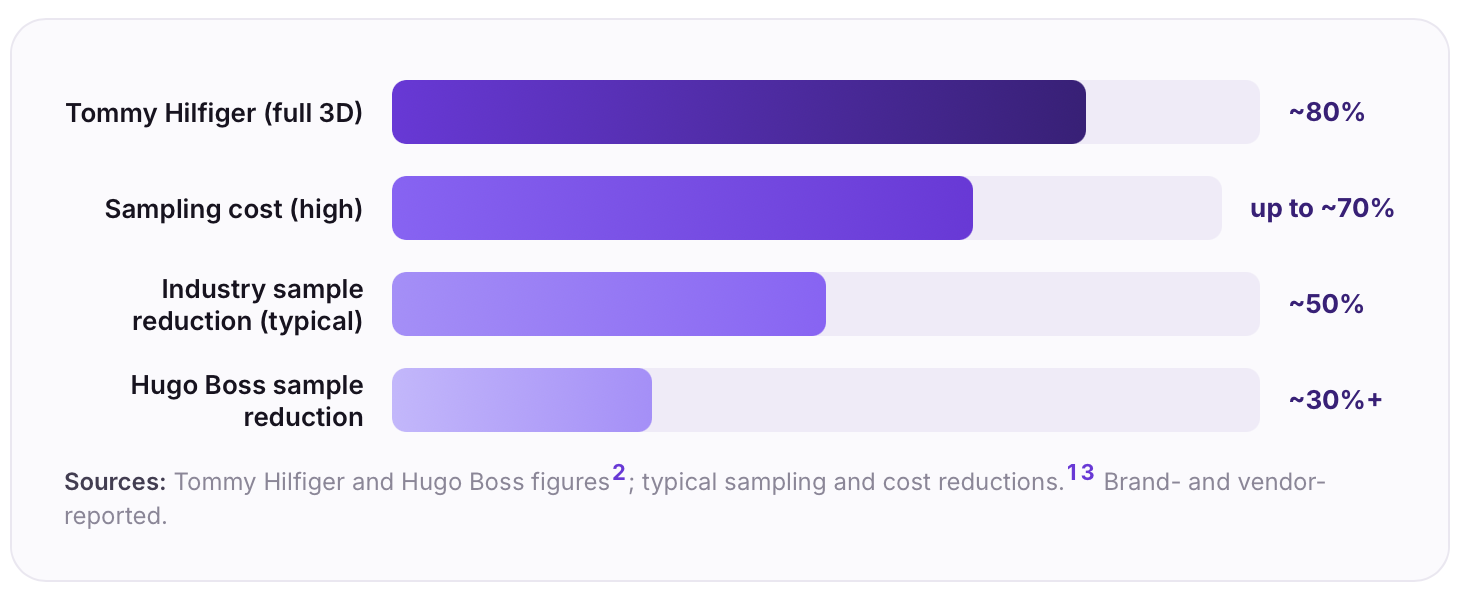
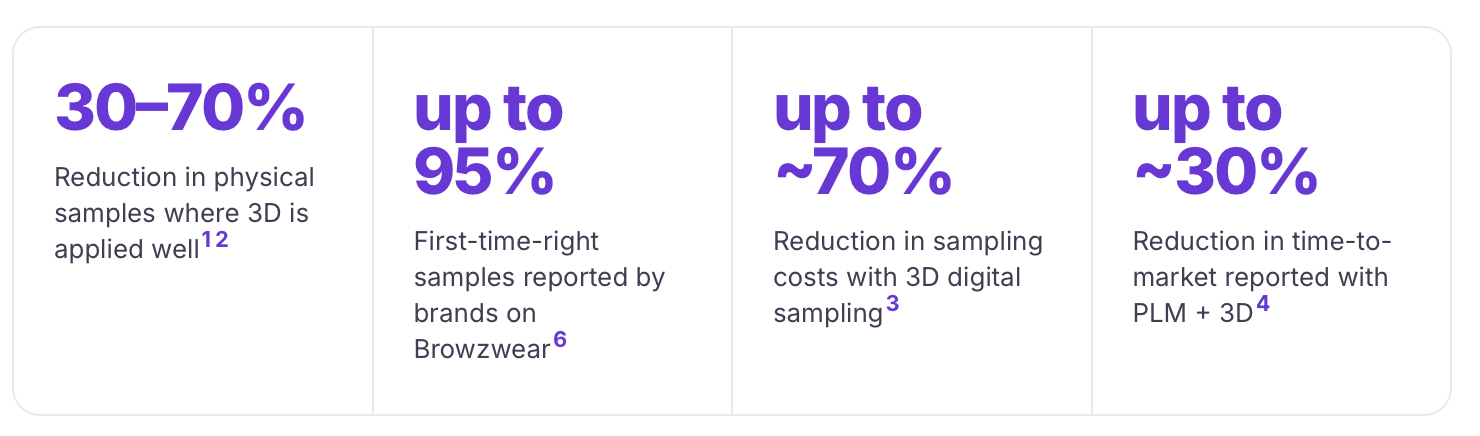
Now the good news, which is very good. Where 3D is connected to the product record and applied to the right work, the payoff is real and measurable. The clearest win is sampling cost. Brands report cutting physical samples by 30–70% with 3D digital sampling, and the committed cases are striking: Tommy Hilfiger reported around an 80% reduction in physical sample production after going fully 3D, Hugo Boss reported a 30%-plus sample reduction alongside roughly 85% faster design times, and Adidas has cited saving over a million material samples.12 Sampling costs specifically have been cut by up to about 70% in some accounts.3
The second real win is speed. Reviewing and revising a digital sample is faster than producing, shipping, and evaluating a physical one, which feeds directly into time-to-market reductions of up to roughly 30%.4 The third is sustainability: every physical sample not made is fabric not cut and shipped, cutting into the 15–25% of materials traditionally wasted on prototypes, a benefit that doubles as compliance-relevant data as traceability requirements arrive.4
The companies building these engines see the same pattern in their own customer data, and they put sharper numbers on it. Browzwear reports that brands on its platform reach up to 95% first-time-right samples, with some product categories going straight to production without a physical development sample at all, while cutting physical sampling by up to 80% and compressing approval cycles that once ran for weeks down to days.6 It also quantifies the flip side: a change made after the production pattern is cut can cost up to ten times what the same change would have cost at the concept stage, which is the real financial argument for catching it in 3D first.6 CLO, the other major engine most brands run, frames the upside the same way, virtual sampling and remote collaboration meaningfully shorten time-to-market, and designing in virtual garments reduces sample production, shipping, and material waste.5 These are partner figures rather than independent audits, but they come from the two tools fashion actually uses, and they track closely with the independent ranges above.
FIGURE 1
Where 3D digital sampling pays off
Reported reductions after connecting 3D to the product record. Brand- and industry-reported; self-reported figures, directionally consistent.
Where it’s still catching up
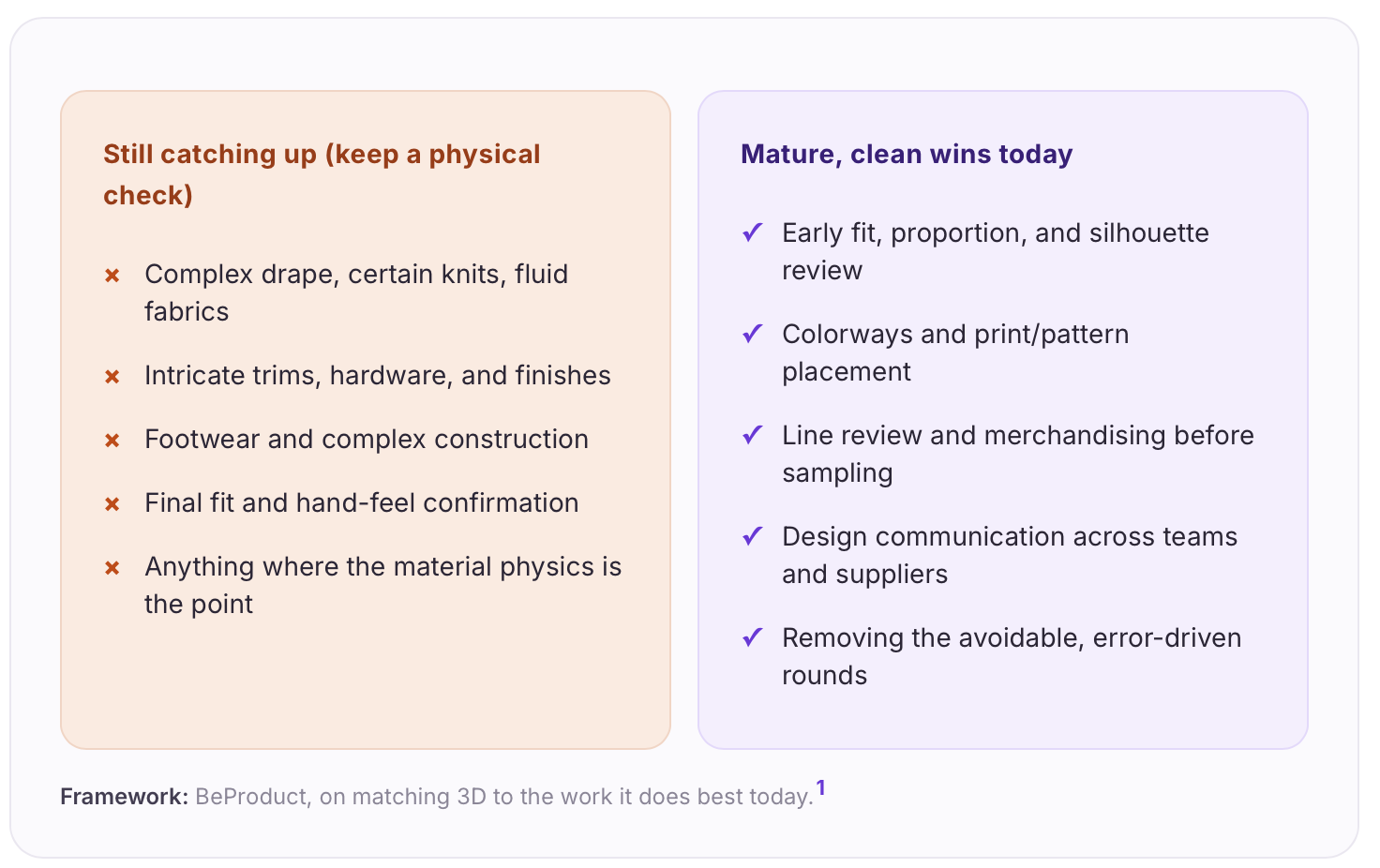
Here’s the part the sales decks skip, and the part that builds trust to say out loud. 3D is genuinely harder today, in some places than others. Highly complex materials and finishes, certain knits and the subtle physics of drape, intricate trims and hardware, and categories like footwear with complex construction are areas where digital simulation is improving fast but isn’t yet a clean replacement for feeling the real thing. For those, 3D is a powerful design and communication tool, but a final physical sample still earns its place. Pretending otherwise is how brands get burned. The right posture isn’t “3D replaces everything,” it’s “3D removes the avoidable rounds, and we keep the rounds that genuinely confirm something physical.”
There’s a distinction here worth borrowing from the people who build these tools. Browzwear draws a hard line between 3D used for design visualization, photorealistic renders for creative review, and 3D used for development, where the model is a production-validated digital twin built on certified mill data and physics-based simulation, accurate enough to stand in as a production reference without a parallel physical sample.6That line is the honest answer to the question every disappointed brand eventually asks: why did our 3D look incredible and save us nothing? A render is a picture. A physics-validated twin is a decision. And the categories where 3D still struggles are mostly the ones where that physics is hardest to simulate, which is exactly why a final physical check still earns its place there, at least for now.
FIGURE 2
Where 3D is mature vs. still catching up
An honest split of where digital product creation delivers a clean win today and where it complements rather than replaces.
Capturing the value without a studio rebuild
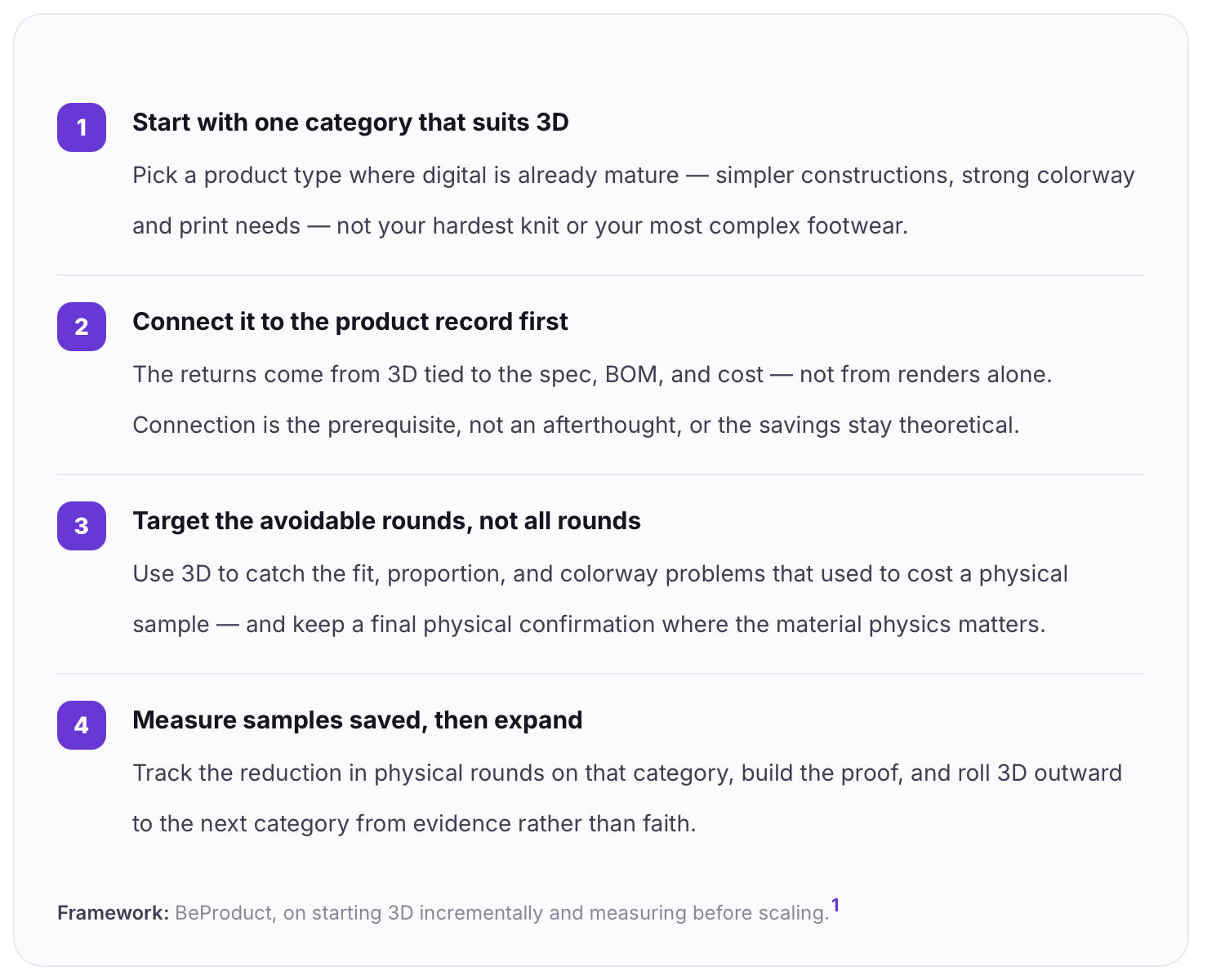
The biggest myth is that 3D requires an all-at-once transformation. It doesn’t, and trying to do it that way is the most common way to fail. The smart path is incremental:
FIGURE 3
A low-risk way to start with 3D
You don’t need a studio rebuild to capture the real returns. Start where the win is cleanest and expand from proof.
Real ROI, honestly scoped
So is 3D worth it? Yes, when you scope it honestly. The returns are real and large where it’s mature and connected to the product record, and overstated where it’s sold as a universal, sample-free replacement for everything. The brands getting genuine value aren’t the ones who believed the full hype or dismissed it entirely. They’re the ones who started small, connected 3D to their data, targeted the avoidable sample rounds, and kept a physical check where the material still demands one. That’s not a compromise on the vision, it’s how the vision actually pays.
The honest reframe
3D isn’t magic and it isn’t hype, it’s a tool with a real, documented ROI in specific places. Connect it to your product record, start with the categories where it’s mature, target the rounds you were going to waste anyway, and keep a physical confirmation where the material physics is the whole point. Scoped that way, the returns are some of the clearest in fashion technology.
The takeaways
The hype and the skepticism are both half-right the returns are real but concentrated, not universal.
Where it wins, it wins big 30–70% fewer samples, up to ~70% lower sampling cost, ~30% faster to market.
Be honest about the limits complex drape, knits, trims, and footwear still warrant a physical check.
Start small and connected one suited category, tied to the product record, measured before you scale.
REFERENCES
Style3D and Apex Fashion Lab analyses (3D digital sampling reduces physical samples ~30–70%; sampling costs cut substantially; start-small and connection guidance). style3d.com · apexfashionlab.com
StyTrix, “Digital Sampling in Fashion” (Tommy Hilfiger ~80% reduction in physical sample production; Hugo Boss ~85% design-time improvement and 30%+ sample reduction; Adidas 1M+ material samples saved). stytrix.com
Apex Fashion Lab, product development guide (3D digital sampling reduces sampling costs up to ~70%). apexfashionlab.com
Style3D industry analyses (time-to-market reduced up to ~30%; ~15–25% material waste, citing McKinsey). style3d.com
CLO Virtual Fashion (CLO3D), a BeProduct 3D/DPC integration partner — product and ESG positioning (virtual sampling and remote collaboration shorten time-to-market; designing with virtual garments reduces sample production, shipment, and material waste). clo3d.com
Browzwear, a BeProduct 3D/DPC integration partner — “The Hidden Cost of Late-Stage Design Changes” and company blog (brands on Browzwear report up to 95% first-time-right samples and up to 80% fewer physical sampling rounds; late-stage changes cost up to ~10× more than at concept stage; production-validated digital twins vs. design visualization). browzwear.com/blog
ROI, sample-reduction, sampling-cost, and time-to-market figures are brand-, vendor-, and partner-reported and vary by product, category, and degree of 3D adoption. CLO and Browzwear are BeProduct 3D/DPC integration partners; their figures are vendor-reported rather than independent audits. Maturity-by-category descriptions reflect general industry practice as of 2026.