
A Day in the Life of a Fashion Designer — and Why So Little of It Is Design
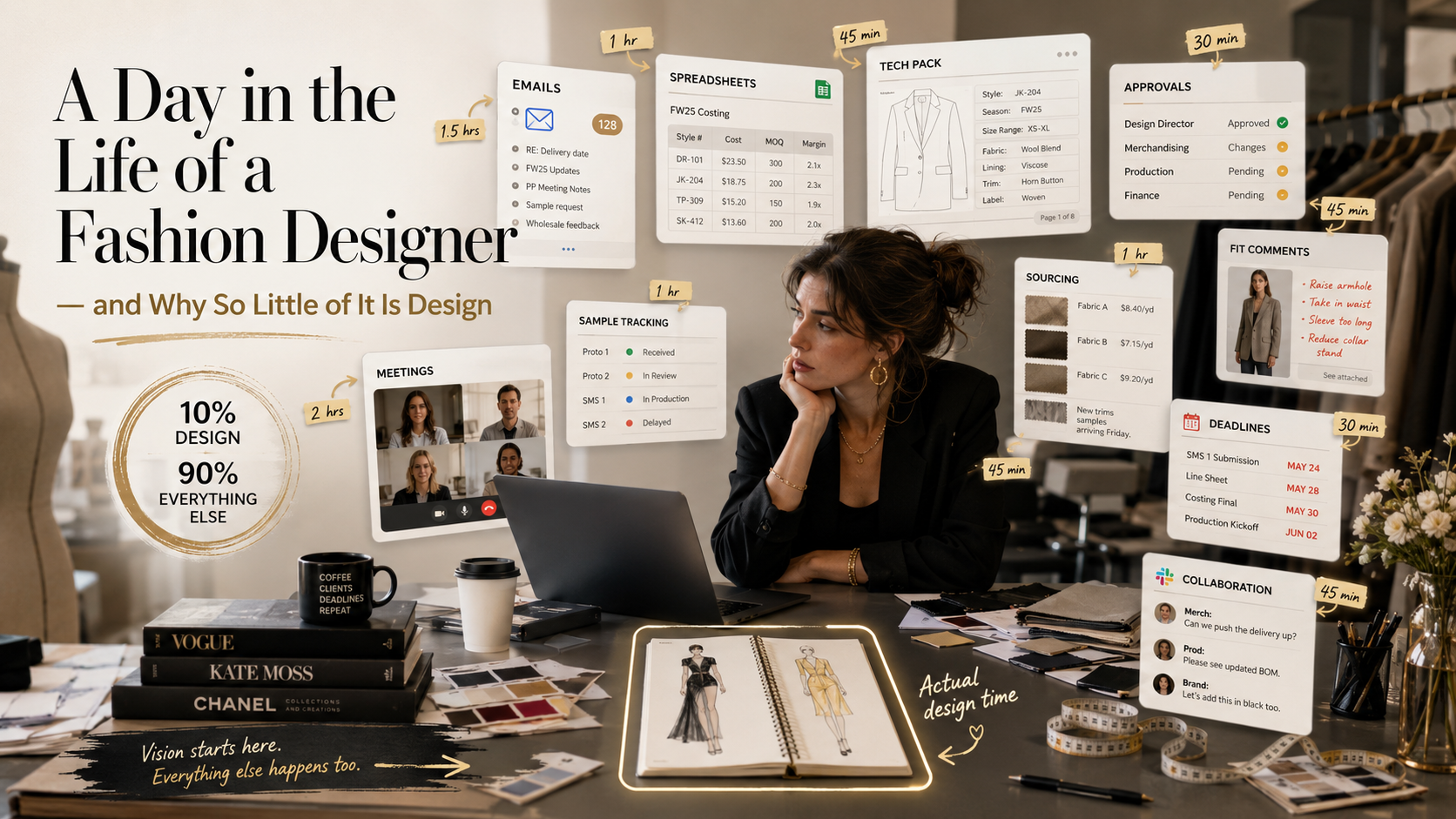
People become fashion designers to create. Then the job arrives, and a startling amount of it turns out to be formatting spreadsheets, chasing sign-offs, and reconciling versions. Here’s what a designer’s day actually looks like — and what the gap between the craft and the chaos costs a brand.
Ask a fashion designer why they got into the work, and you’ll hear about creating, the sketch, the fabric, the thrill of an idea becoming a thing people wear. Then ask what they actually did yesterday, and the answer sounds very different: reformatting a tech pack so the factory could read it, hunting through email for the latest comments, rebuilding a measurement chart that broke when someone copied the file, sitting in a meeting to establish which version of a spec was the real one, and chasing three different people for an approval that was supposedly given last week. The romantic image of fashion design and the day-to-day reality of it have quietly drifted miles apart. For a lot of designers, the actual creative work, the reason they’re there, is squeezed into the margins of a day mostly spent on coordination and admin. That gap isn’t just bad for morale. It’s expensive for the brand.
This isn’t a complaint about designers being precious. It’s a description of a workflow that wastes its most valuable people, and it shows up directly in slower development, more errors, and the steady attrition of talented teams who didn’t sign up to be human file-management systems. Let’s walk through where the day actually goes.
Where the design day actually goes
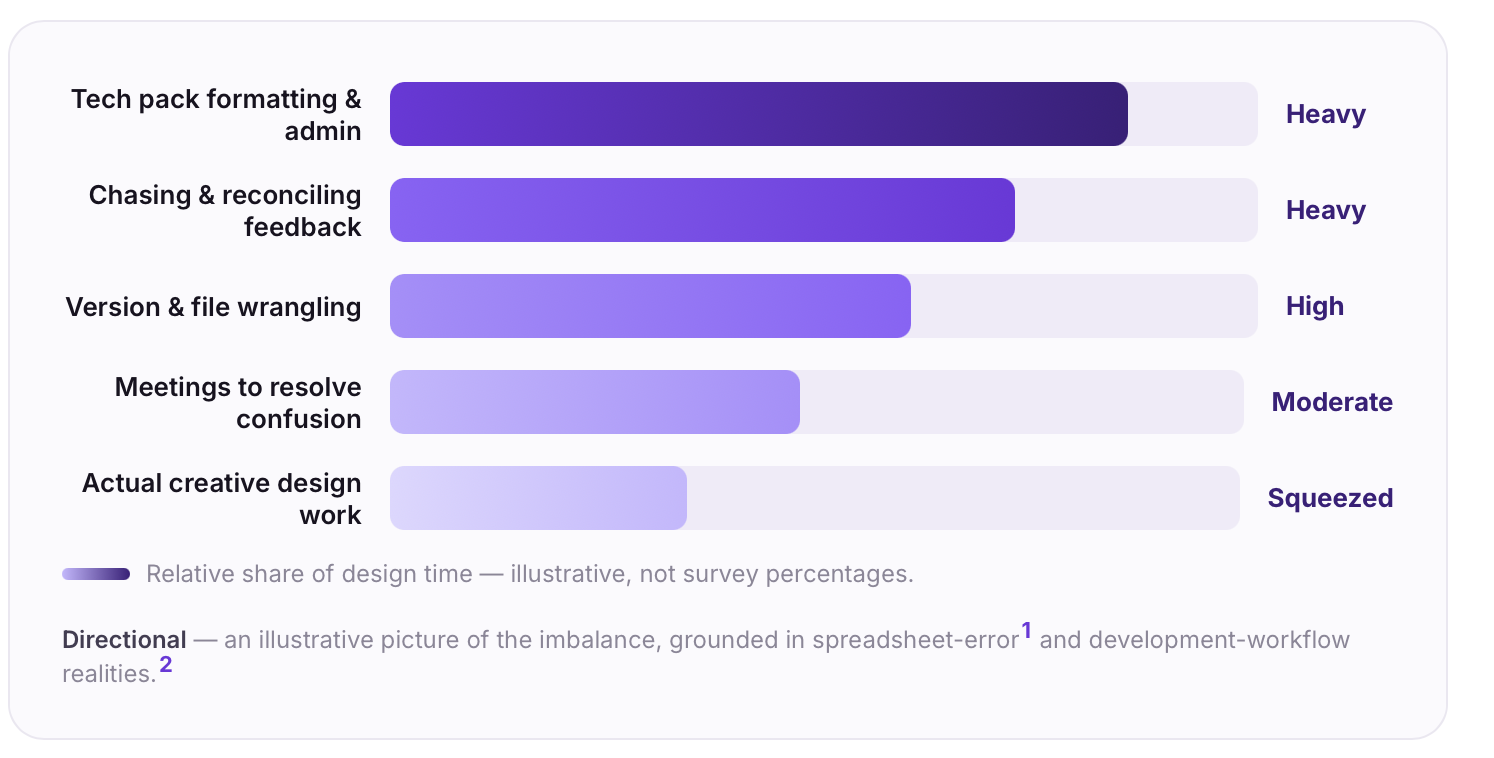
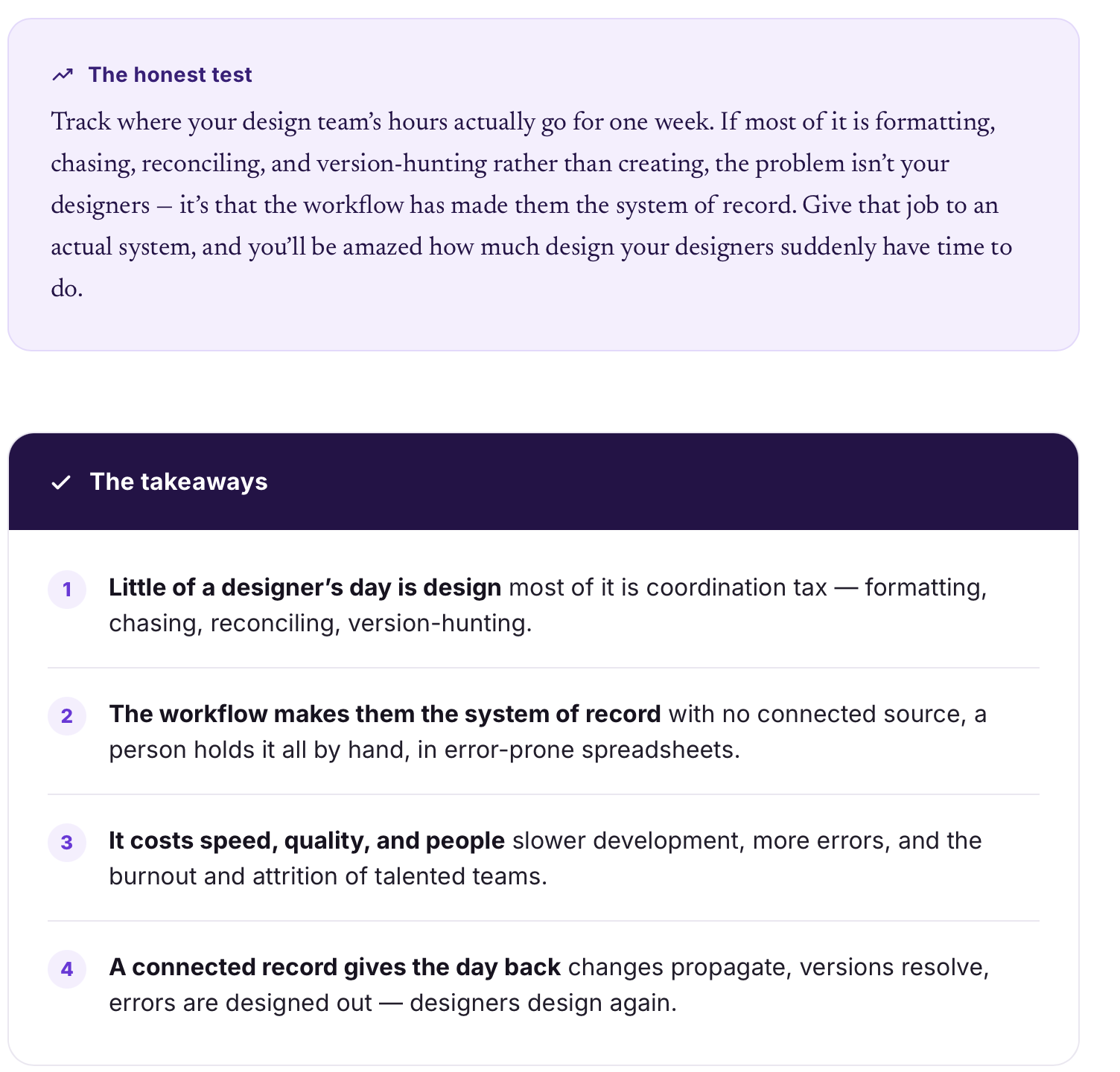
The truth most brands don’t measure is how little of a designer’s time goes to design. Between formatting and reformatting tech packs, chasing and reconciling feedback, manually updating BOMs and measurement charts, tracking down the current version of everything, and the meetings that exist mostly to resolve confusion, the pure creative work, the part only a designer can do, often ends up as a thin slice of the week. The rest is coordination tax: necessary work, poorly supported by the tools, that any well-built system should absorb. And it compounds, because every one of those manual tasks is also a chance for an error to enter, which generates more rework, which eats more of the day.
A startling amount of a designer’s day is coordination tax, necessary work, badly supported by the tools, that a real system should simply absorb.
FIGURE 1
Where a designer’s week tends to go
A directional picture of how design time gets consumed when the workflow runs on spreadsheets and email, illustrative, not survey data.
A workflow that makes designers do the system’s job
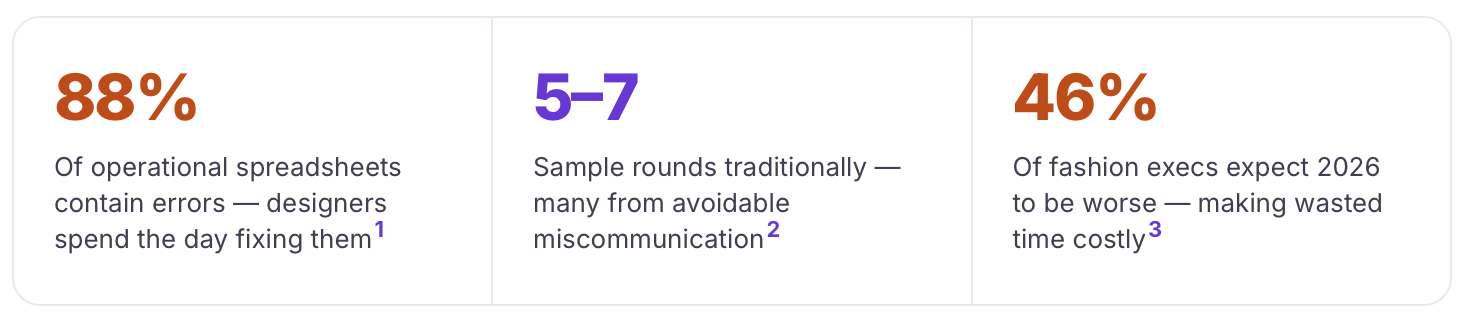
Why does it happen? Because in a manual workflow, the designer becomes the system of record. There’s no connected place holding the spec, the BOM, the materials, the feedback, and the current version, so a person has to hold it , by hand, in spreadsheets and email and memory. That’s work the tooling should do, offloaded onto the most expensive and least appropriate resource for it. With roughly 88% of operational spreadsheets containing at least one error, the designer isn’t just doing the system’s job; they’re doing it in a medium that quietly introduces mistakes, which means a chunk of their day is spent finding and fixing problems the medium created. 1 Add the five-to-seven sample rounds that a traditional process runs, many of them driven by exactly these errors and miscommunications, and you can see how the creative work gets buried under the consequences of an unsupported workflow.2
What wasting designers actually buys the brand
This isn’t a soft problem, and 2026 makes it a sharper one. The cost shows up three ways. It shows up in speed, a designer spending most of their time on admin is a development process moving at a fraction of its potential, in a year when McKinsey and BoF found 46% of fashion executives expecting conditions to worsen and efficiency becoming a survival skill rather than a nicety.3 It shows up in quality, errors from manual work become wrong samples and missed details. And it shows up in peopled talented designers burn out and leave when the job becomes mostly file management, taking their craft and institutional knowledge with them. Wasting your designers’ time isn’t a quirk of the industry; it’s a direct tax on speed, quality, and retention.
Give the admin to a system, give the day back to design
The answer isn’t to ask designers to be more organised, it’s to stop making them be the system. When the spec, BOM, materials, feedback, and version history live on a single connected product record, the coordination tax largely disappears: changes propagate instead of being re-keyed, there’s one current version instead of a hunt, feedback attaches to the exact style instead of scattering across email, and the errors that generate rework are designed out. The designer stops being a human file-management system and goes back to being a designer. That’s not a productivity nicety; in a margin-squeezed year, it’s how a brand gets more creative output and faster development from the same team.
The digital-product-creation toolchain extends the same principle to the creative work itself. Connected to the record, CLO’s true-to-life visualization and Browzwear’s production-validated digital twins let designers iterate, review, and refine virtually, spending time creating and deciding rather than waiting on physical samples and chasing the rounds that distance and error used to require. 45 The whole point of the modern toolchain is to return the day to the design.
REFERENCES
R. Panko, University of Hawaii, “What We Know About Spreadsheet Errors” (~88% of operational spreadsheets contain at least one error; ~5% average cell error rate). panko.shidler.hawaii.edu
Apex Fashion Lab, product development guide (typically 5–7 sample rounds from proto to production-ready). apexfashionlab.com
McKinsey & Company and BoF Insights, “The State of Fashion 2026” (46% of fashion executives expect industry conditions to worsen in 2026, up from 39%; efficiency and productivity as core 2026 priorities). mckinsey.com
CLO Virtual Fashion (CLO3D), a BeProduct 3D/DPC integration partner (true-to-life virtual garment visualization; virtual sampling and remote collaboration that free designers to create rather than wait). clo3d.com
Browzwear, a BeProduct 3D/DPC integration partner (production-validated digital twins for fast virtual iteration and review; assets export to PLM/ERP). browzwear.com/blog
The time-allocation chart is illustrative, grounded in workflow and spreadsheet-error research; it is not a single time-study survey. CLO and Browzwear are BeProduct partners; their capabilities are vendor-reported.
© 2026 BeProduct · Wink Software LLC