
Fashion PLM vs. Engineering PLM: Why the Difference Matters
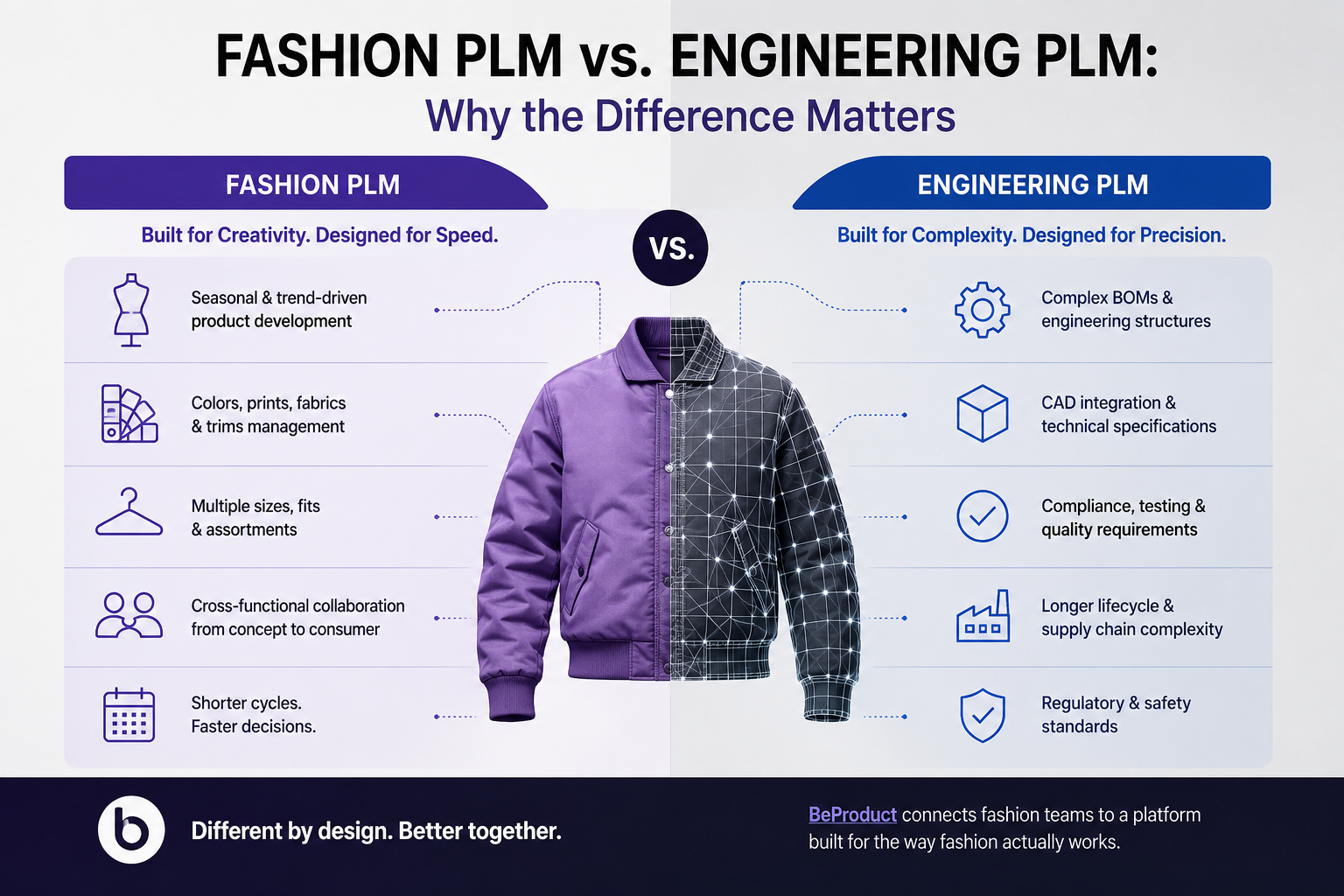
Not all PLM is built for fashion. Repurposed engineering platforms and fashion-native ones solve different problems for different teams. Here’s the honest comparison, and how to tell which you actually need.
“PLM” is one acronym covering two genuinely different kinds of software, and conflating them is one of the most expensive mistakes a fashion brand can make in a buying process. Product Lifecycle Management was born in manufacturing and engineering, managing the design and production of cars, aircraft, machinery, electronics. Fashion adopted the concept later, and some vendors adapted heavy engineering platforms to apparel while others built systems from the ground up for how fashion actually works. They share three letters. They do not share a fit. Understanding the difference is the difference between software that accelerates your team and software that fights it.
This isn’t a knock on engineering PLM, for engineering, it’s excellent. It’s about matching the tool to the work. Let’s lay out where the two diverge, why it matters for a fashion team specifically, and how to tell which one your brand needs.
Two different problems, two different tools
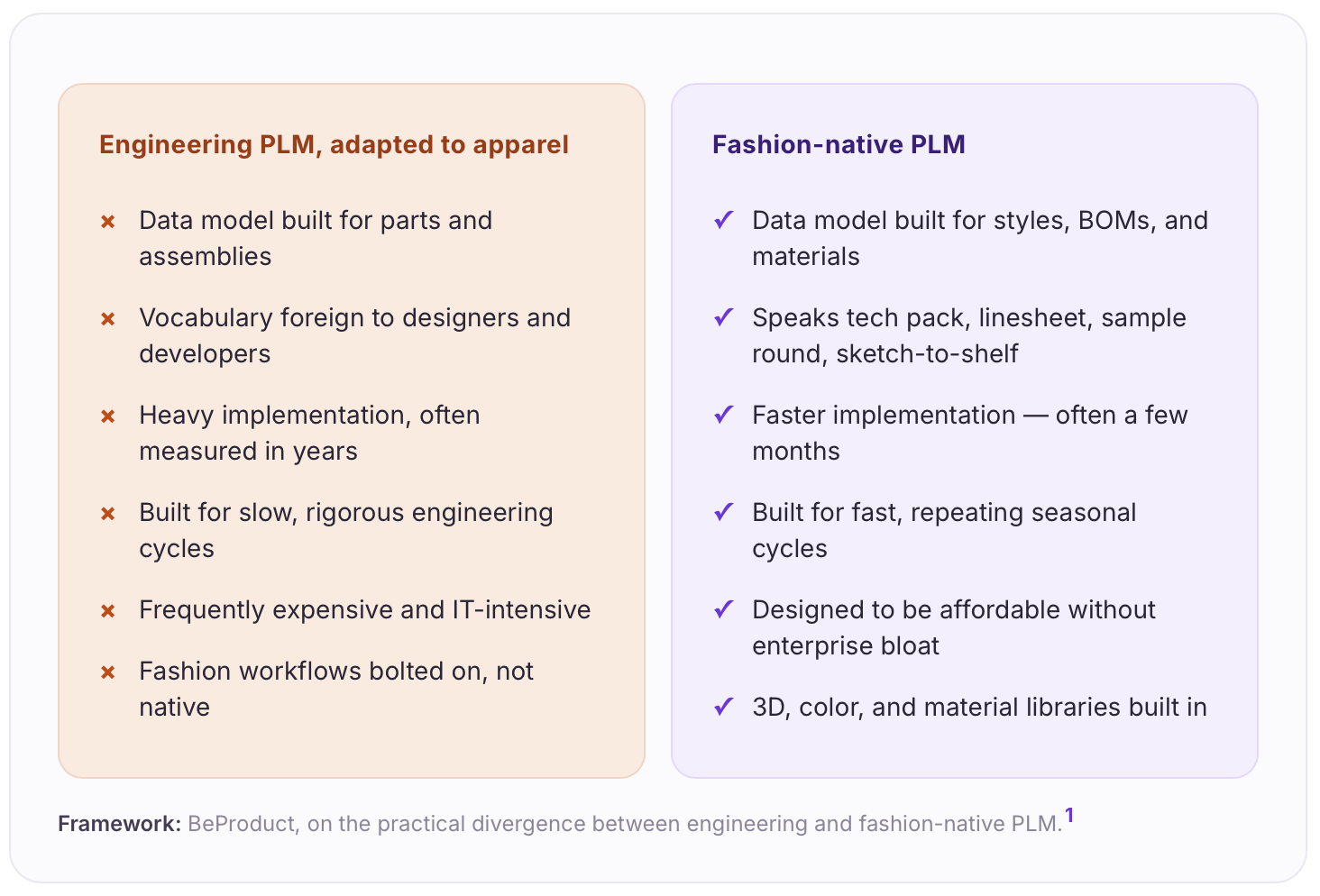
Engineering PLM was designed around CAD files, complex multi-level assemblies, part numbers, and rigorous change-control for products where a single component failure can be catastrophic. Its data model thinks in parts and sub-assemblies, its workflows assume long engineering cycles, and its implementations are often measured in years. That’s exactly right for an aircraft. It’s a strange fit for a seasonal apparel line.
Fashion-native PLM was designed around a different reality: seasonal collections, tech packs, bills of materials measured in fabrics and trims, color and material libraries, size runs, sample rounds, and a calendar that turns over several times a year. Its data model thinks in styles and materials, its workflows assume fast seasonal cycles, and, critically, it speaks the vocabulary a designer and a developer already use. The result is software that fits the work instead of asking the work to fit the software.
Engineering PLM and fashion PLM share three letters and almost nothing else. One is built for parts and assemblies; the other for styles and seasons.
Where the two genuinely diverge
FIGURE 1
Fashion-native PLM vs. repurposed engineering PLM
The practical differences that show up every day for a fashion product team.
The cost of the wrong fit
Choosing engineering PLM for a fashion team isn’t just suboptimal, it’s actively costly in three ways. First, adoption: software that doesn’t speak your team’s language gets resisted, worked around, and under-used, which means you pay for capability you never realize. Second, implementation: heavy platforms built for engineering rigor take far longer and cost far more to stand up, often requiring dedicated IT and consultants, a multiple of the sticker price before any value appears. Third, fit: a data model built for parts and assemblies forces fashion concepts into shapes that don’t match, so the team spends energy translating instead of working.
This is precisely the trap that drives so many mid-market brands to a fashion-native alternative. As BeProduct customer KOOKAÏ put it, the larger PLM vendors’ platforms were either very expensive or very basic, the heavy enterprise systems on one end, the too-simple tools on the other, with little built specifically for a fashion team that needs depth without bloat.2

A short diagnostic
You almost certainly need fashion-native PLM if most of these are true:
Your products are styles and collections that turn over by season, not engineered assemblies with long lifecycles.
Your team thinks in tech packs, BOMs of fabrics and trims, color and material libraries, and sample rounds.
You want 3D and digital product creation connected to the product record, not a separate engineering CAD pipeline.
You need to be live in months, not years, without a dedicated IT department to run it.
You want depth built for fashion, without paying for, or fighting, an enterprise engineering platform.
If you’re building turbines, by all means use engineering PLM. If you’re building a seasonal apparel or footwear line, the fashion-native answer isn’t a compromise, it’s the tool that was actually designed for your work.
Match the tool to the team
The PLM category’s growth, the fashion and apparel segment expanding at roughly 11–12% a year, has attracted both kinds of vendor into the same search results, which is exactly why the distinction gets blurred.4 But the right question was never “which PLM is best?” It’s “which PLM is built for what we actually make?” For a fashion brand, that’s a fashion-native platform: one that speaks your vocabulary, fits your calendar, connects your 3D, and stands up in months, giving you the depth of a real system of record without the weight of a tool built for an entirely different industry.
The honest reframe
Engineering PLM is superb, for engineering. The mistake isn’t choosing it; it’s choosing it for fashion. Match the tool to the team: a fashion-native product record fits how designers and developers actually work, which is what determines whether the software gets adopted, pays back, and accelerates your season instead of slowing it.
The ecosystem makes the point. Fashion-native 3D and DPC tools like CLO and Browzwear are built to integrate with fashion PLM, Browzwear’s assets export directly into PLM and ERP, not with engineering CAD pipelines. A fashion-native product record speaks the same language as the tools your designers already use, which is precisely what an engineering platform does not.56
The takeaways
PLM is two different tools engineering PLM (parts and assemblies) and fashion-native PLM (styles and seasons).
The wrong fit is costly poor adoption, heavy multi-year implementation, and a data model that fights fashion concepts.
Fashion-native fits the work tech packs, material libraries, 3D, seasonal cycles, and a months-not-years rollout.
Match the tool to what you make for a seasonal apparel line, fashion-native isn’t a compromise, it’s the right answer.
REFERENCES
BeProduct, platform positioning (fashion-native PLM and digital product creation built for apparel, footwear, and accessories teams). beproduct.com
KOOKAÏ customer reference and BeProduct pricing, via BeProduct (larger PLM vendors seen as “either very expensive or very basic”; $75 per user/month, no upfront infrastructure). go.beproduct.com
Style3D industry analyses (modern cloud fashion PLM typically implements in ~3–6 months versus far longer for heavy enterprise rollouts). style3d.com
Univdatos Market Insights and Verified Market Research, fashion/apparel PLM software market (~11–12% CAGR). verifiedmarketresearch.com
CLO Virtual Fashion (CLO3D), a BeProduct 3D/DPC integration partner — product and ESG positioning (true-to-life virtual garment visualization; virtual sampling and remote collaboration shorten time-to-market; designing in virtual garments reduces sample production, shipment, and material waste). clo3d.com
Browzwear, a BeProduct 3D/DPC integration partner — company blog and product information (brands report up to 95% first-time-right samples and up to 80% fewer physical sampling rounds; late-stage design changes cost up to ~10× more than at concept stage; production-validated digital twins built on certified mill data; Fabric Analyzer measures physical fabric properties; assets export to PLM/ERP). browzwear.com/blog
Implementation timescales and pricing vary by vendor, scope, and brand. Comparisons describe general category characteristics, not any single competing product.