
Forget the Metaverse: Fashion’s Real Tech Future Is Composable and Agentic
The embodied-internet dream that fashion spent years chasing is now firmly buried. What’s replacing it is drier, more practical, and arguably more disruptive: a future of composable software and AI agents that plug into one another — and that future has one hard prerequisite most brands haven’t built.
By BeProductJune 20268 min readSeries: The State of Fashion PLM
Remember when the future of fashion technology was going to be an embodied internet — avatars, virtual storefronts, a 3D metaverse where we’d all shop in digital twins of physical malls? That vision is now firmly in the ground, and few people are mourning it. But something is rising in its place, and it deserves far more attention than the metaverse ever did, precisely because it’s so much less flashy. The real future taking shape is composable: software built from interchangeable, interoperable pieces, increasingly orchestrated by AI agents that can move between tools, pull data, and get work done. It’s a quieter idea than a virtual world, but it’s a more disruptive one — and it changes what a brand should be buying, building, and prioritising. There’s just one catch, and it’s the part everyone skips.
That catch is connection. Composable tools and AI agents only deliver if the data underneath them is connected and structured enough to move between them. Get that right and the composable future is an enormous advantage; get it wrong and you’ve just bought more disconnected tools.
From one big suite — or one big metaverse — to a marketplace of capabilities
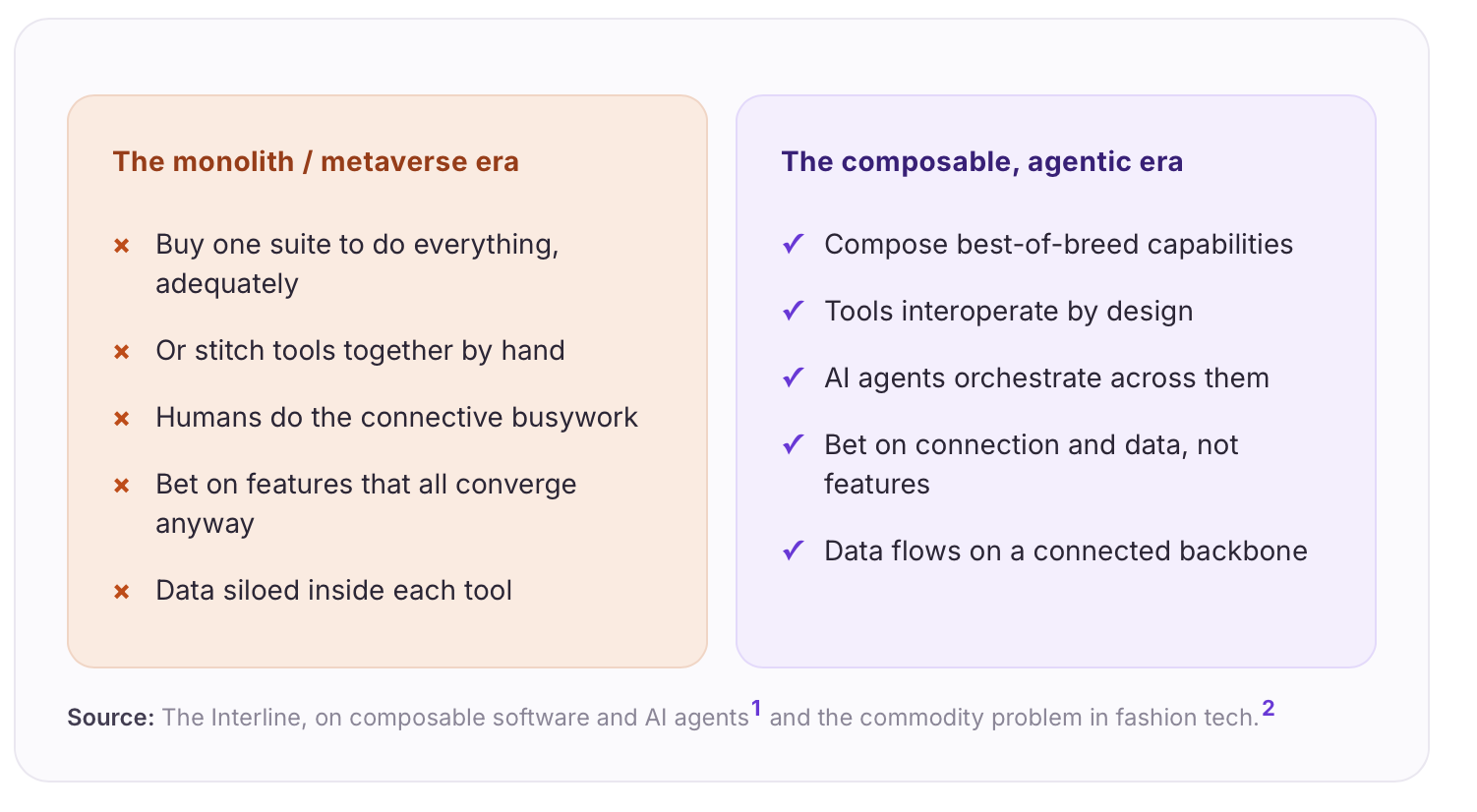
The Interline put the change plainly: forget the metaverse; the future web is a marketplace of tools and capabilities, with composable software and AI agents painting a much drier but more practical — and more disruptive — picture for fashion.1 The old debate was monolith versus best-of-breed: one giant suite that does everything adequately, or a collection of specialist tools you stitch together yourself. Composability dissolves that choice. The premise is that the best specialist tools should interoperate cleanly, and that AI agents can increasingly orchestrate them — moving data, triggering actions, and handling the connective work humans used to do by hand. The winning stack isn’t the biggest suite or the cleverest single tool. It’s the best capabilities, composed together, with data flowing between them.
Composability dissolves the old monolith-versus-best-of-breed debate. The winning stack is the best capabilities, composed together — with data flowing between them.
A builder-state where everyone makes the same thing
There’s a flip side worth naming, because it shapes how you should buy. As technology matures and anyone can build almost anything, the industry has tipped into what The Interline calls a builder-state — where, in the short term, everyone makes broadly the same thing, and a messy shakeout becomes inevitable.2 For brands, the lesson is to stop buying tools for their feature lists, which increasingly converge, and start buying for how well they connect and compose. In a market where capabilities are becoming commodities, interoperability and a solid data foundation are the things that actually differentiate — and the things most likely to survive the shakeout.
FIGURE 1
The old stack vs. the composable, agentic stack
Why the question shifts from “which tool does the most?” to “which capabilities compose, and what connects them?”
Composability needs a connected data backbone
Here’s why so many “modern stack” projects quietly fail: composability is a data problem before it’s a tooling problem. Tools can only compose if they share data cleanly, and AI agents can only orchestrate work if there’s a structured, connected source for them to read from and write to. Bolt a dozen best-of-breed tools onto a foundation of disconnected spreadsheets and you don’t get a composable stack — you get a dozen new silos and a lot of manual copying between them. The connected product record is what makes the rest possible: a structured backbone that specialist tools plug into and agents operate on, so the whole stack behaves like one system instead of a pile of parts. The brands ready for the composable future aren’t the ones with the most tools; they’re the ones with the cleanest connective layer underneath them.
The 3D and digital-product-creation partners model exactly this principle. Browzwear is built around an open platform whose assets export cleanly into PLM and ERP, and CLO has repeatedly recommitted to connecting the DPC ecosystem rather than walling it off — both betting that the value is in interoperation, not isolation.34 That’s composability in practice: best-of-breed 3D capability that plugs into the record instead of becoming another island. The same logic should guide every tooling decision you make from here.
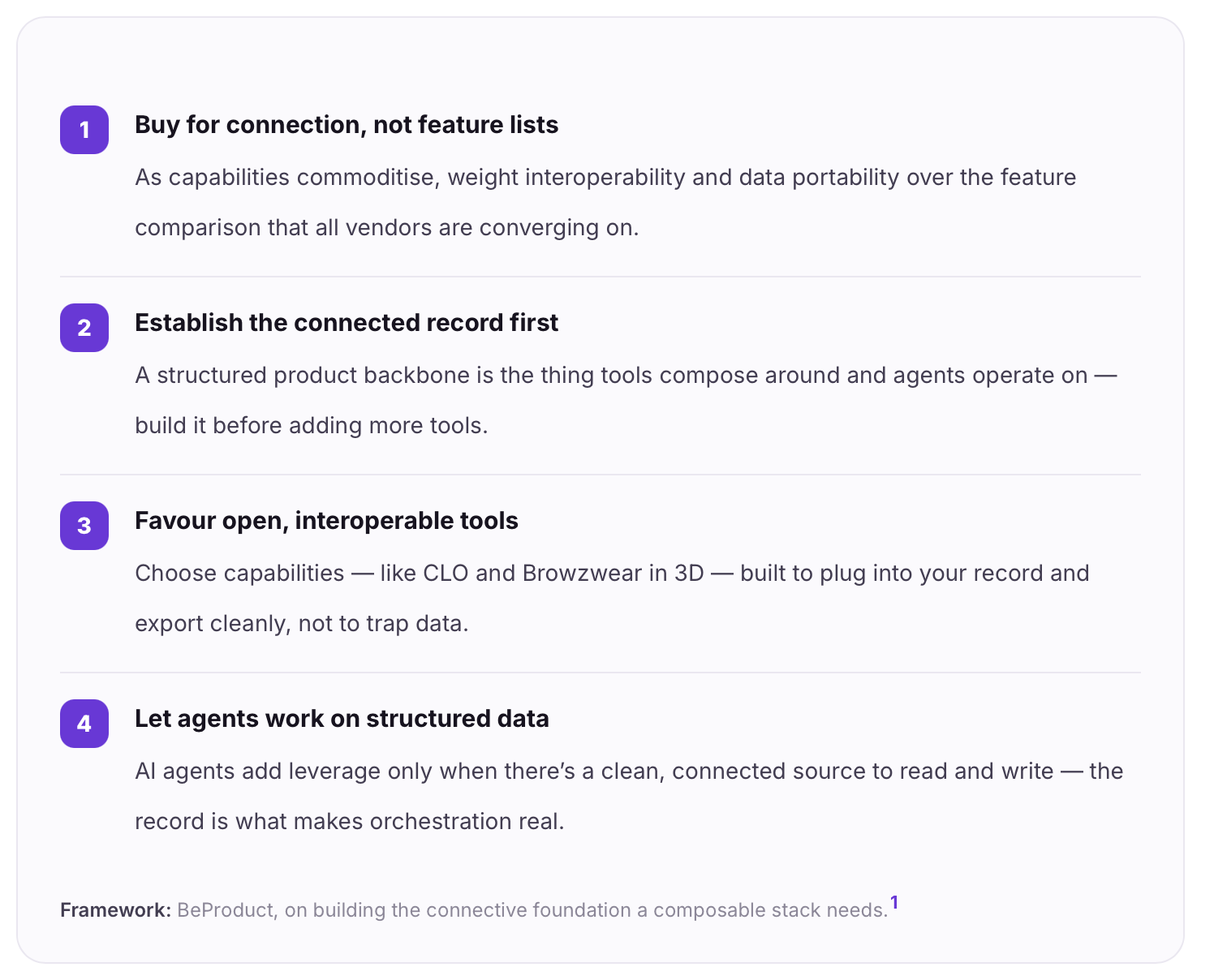
FIGURE 2
Building for a composable, agentic future
The metaverse asked you to buy a world. The composable future asks you to build a connective foundation. Here’s how.

Stop buying tools, start building connective tissue
The metaverse was a seductive distraction; the composable, agentic future is the real and far more useful disruption — and it rewards a completely different kind of preparation. Not a virtual world, not the biggest suite, not the longest feature list, but a connected data foundation that lets the best capabilities compose and lets AI agents actually work. As tool features commoditise and a shakeout sorts the market, the brands with that connective tissue in place will assemble exactly the stack they need and adapt as it evolves. The ones still buying disconnected tools will keep accumulating silos. The future isn’t a place you go — it’s a foundation you build, and it starts with the record everything else plugs into.
The reframe
Forget the metaverse, and forget the monolith-versus-best-of-breed debate too. The real question is connection: can your tools compose, and can agents work across them? That’s a data problem, and the connected product record is the answer. Build the connective tissue first, and the composable future becomes an advantage instead of just more tools to manage.
The takeaways
The metaverse is dead; composability is the real future best-of-breed capabilities plus AI agents that orchestrate across them.
Buy for connection, not features as capabilities commoditise and a shakeout looms, interoperability is what differentiates.
Composability is a data problem first tools only compose, and agents only work, on a connected, structured backbone.
The partners model it CLO and Browzwear bet on plugging into the ecosystem and exporting cleanly, not walling data off.
REFERENCES
The Interline, “Forget The Metaverse, The Future Web Is A Marketplace Of Tools And Capabilities” (the embodied internet is buried; composable software and AI agents paint a drier, more practical, more disruptive future for fashion). theinterline.com
The Interline, “The Commodity Problem In Fashion Technology” (a builder-state where anyone can make anything means everyone creates the same thing in the short term, and a shakeout is coming). theinterline.com
Browzwear, a BeProduct 3D/DPC integration partner — Open Platform; assets export cleanly into PLM and ERP rather than locking data in a single tool. browzwear.com/blog
CLO Virtual Fashion (CLO3D), a BeProduct 3D/DPC integration partner — connected design hub and repeated public commitment to connecting the DPC ecosystem rather than walling it off (as covered by The Interline, “In London, CLO Recommits To Connecting The DPC Dots”). clo3d.com · theinterline.com
The composable/agentic framing reflects current industry reporting (The Interline) and an emerging direction, not a settled state. CLO and Browzwear are BeProduct partners; their capabilities are vendor-reported.