
Tariffs, Margin, and the 2026 Sourcing Squeeze: Why Data Now Beats Cheap Labor
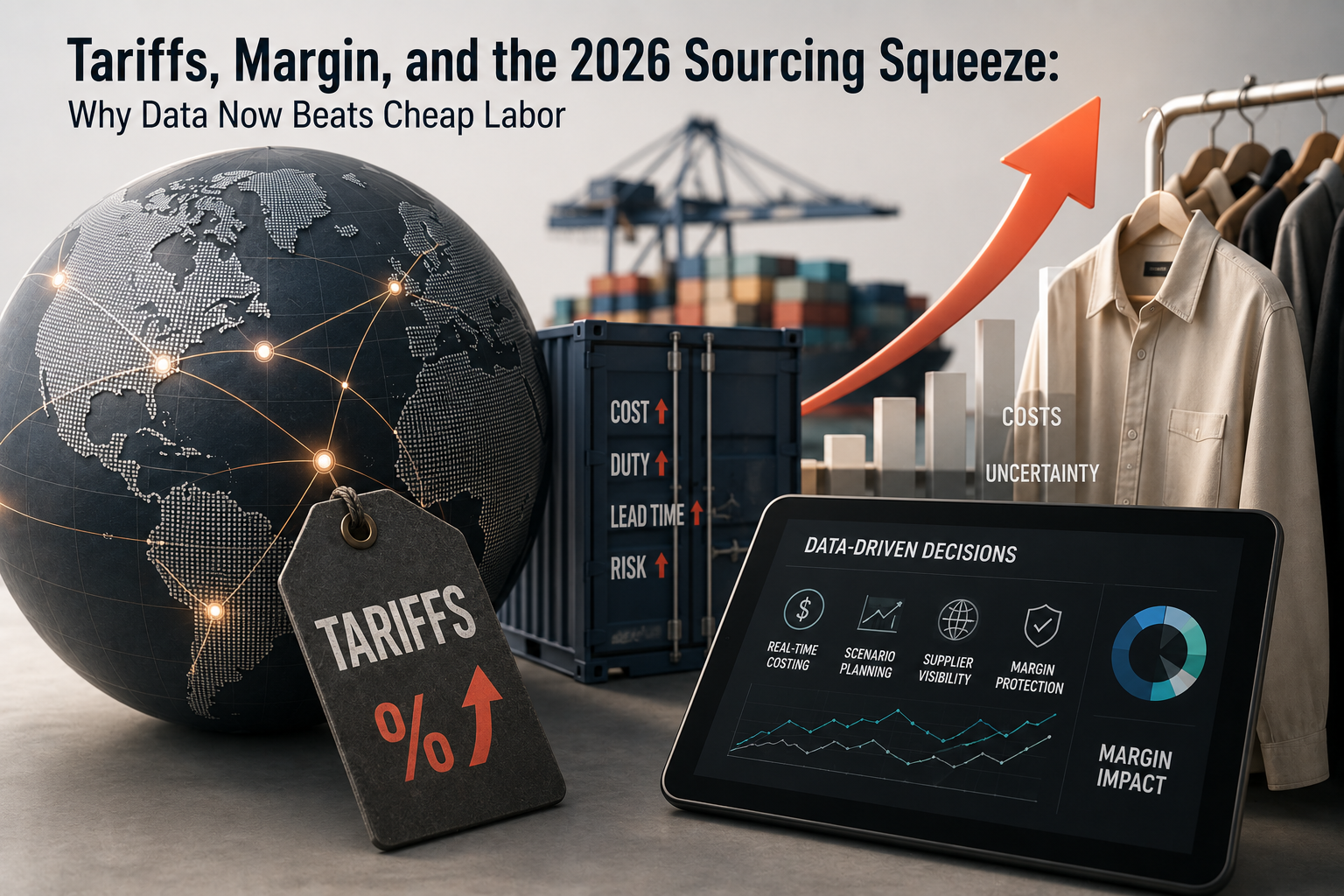
In 2026, tariffs became the single biggest force in fashion. Average US apparel duties more than doubled in a year, sourcing maps were redrawn overnight, and margins came under pressure everywhere. The brands handling it best have stopped optimising for the cheapest labour and started competing on something else entirely: agility and data.
By BeProductJune 20269 min readSeries: The State of Fashion PLM
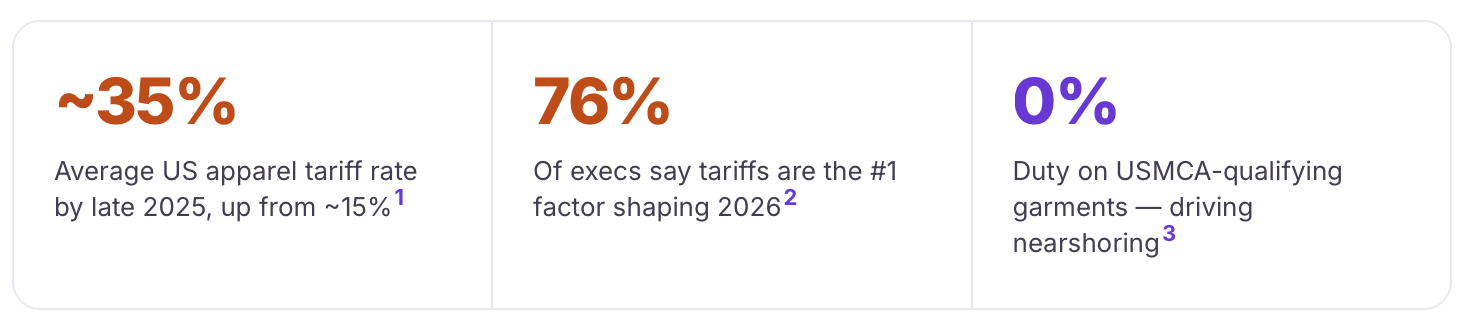
For decades, apparel sourcing followed one rule above all others: find the cheapest reliable labour and produce there. In 2026, that rule broke. A wave of tariffs has rewritten the economics of where and how fashion gets made, and the numbers are not subtle. The average tariff rate on US apparel imports reached around 35% by late 2025, up from under 15% a year earlier — a decades-high level that turned a stable cost line into a volatile one overnight.1 For an industry where the US imports the overwhelming majority of the apparel it sells, this isn’t a line-item nuisance; it’s a fundamental shift in cost structure. And it has produced a striking realisation across the industry: the cheapest factory is no longer the smartest sourcing decision. Trade policy, agility, and data have taken over — and the brands that understand that are protecting margins that everyone else is losing.
This is the defining operational story of fashion in 2026, and it’s worth being precise about the scale, the response, and why the winning move is no longer about labour cost at all.
The numbers behind the squeeze
Start with how big this actually is. McKinsey and BoF found that 76% of fashion executives believe their response to trade disruption and tariffs will be the single most important factor shaping the industry in 2026 — not AI, not consumer trends, tariffs.2 McKinsey estimated tariffs would drive short-term sourcing price increases of roughly 35% for apparel and 37% for leather goods, and 45% of executives said sourcing costs are the pressure their economic model feels most.2 The concrete examples are stark: a $10 garment imported from Bangladesh that once carried near-zero duty now carries around $3.70 in tariffs alone.3 For a sector built on thin margins and the US reliance on imported product, a shift of that magnitude lands directly on profitability.
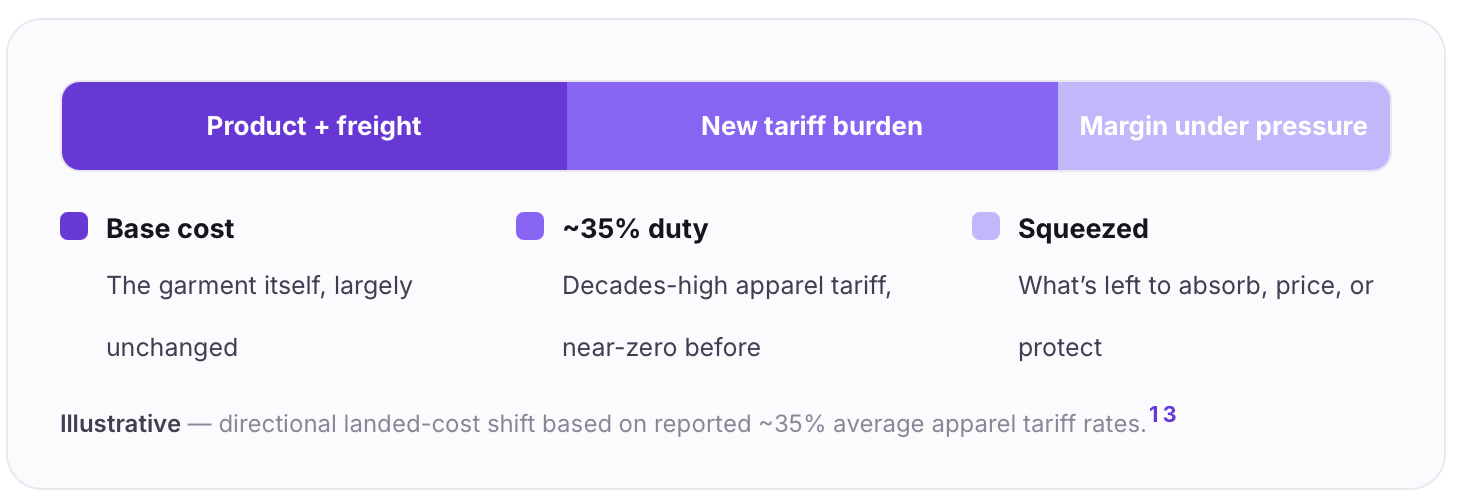
A $10 garment from Bangladesh that once carried near-zero duty now carries about $3.70 in tariffs — a cost shock landing straight on margin.
FIGURE 1
What tariffs did to landed cost
An illustrative landed-cost comparison for a basic imported garment, before and after the 2026 tariff environment. Directional, based on reported rates.
How brands are actually reacting
Faced with this, the biggest brands have moved on several fronts at once, and the moves tell you where the leverage is. They’re shifting sourcing — away from high-tariff Asian origins and toward USMCA partners like Mexico, where qualifying garments can enter at 0%, driving a major push toward nearshoring in the Western Hemisphere.3 They’re raising prices selectively, mostly on premium and fashion-forward items while shielding price-sensitive basics. They’re tightening assortments — value players like H&M and Bershka cut SKUs by 15–25% to free up capital and react faster. And critically, they’re leaning on efficiency and data: McKinsey’s analysis points to digitised sourcing and better forecasting as levers that can materially reduce input costs.2 The throughline is that the response is operational, not just commercial — and operational responses run on data.
Trade policy beat factory efficiency — and data beat both
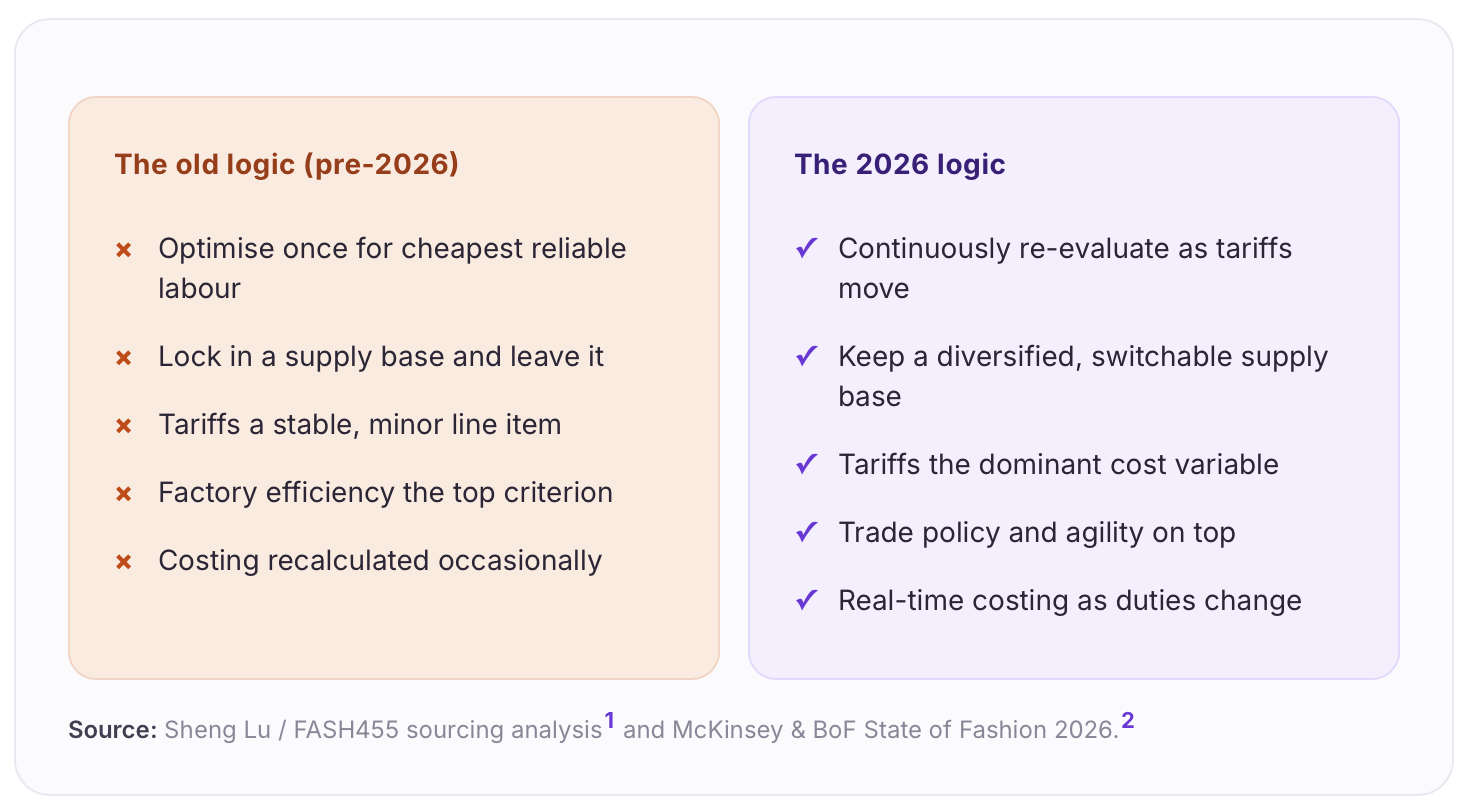
Here’s the deeper change, and the one with the most strategic weight. Sourcing analysts now observe that trade policy has become the most important sourcing criterion — ahead of factory efficiency itself.1 The cheapest, most efficient factory in a high-tariff country can be the wrong choice; a slightly less efficient one in a free-trade partner can win on landed cost. But the real shift is this: in a world where the right sourcing answer changes with every tariff move, sourcing decisions must be continuously re-evaluated rather than optimised once and locked in.1 That makes agility the actual competitive advantage — the ability to re-cost a product instantly when duties change, re-issue a tech pack to a new supplier in a different country quickly, and model sourcing scenarios on real data. The brands winning aren’t the ones who found the cheapest factory. They’re the ones who can move fastest when the map redraws itself again.
FIGURE 2
The old sourcing logic vs. the 2026 logic
Why “find the cheapest labour and lock it in” became the wrong strategy almost overnight.
Why margin protection is now a data problem
If the response to tariffs is operational and the advantage is agility, then margin protection in 2026 is fundamentally a data problem — and this is where a connected product record becomes a competitive tool rather than back-office plumbing. When your product data lives in one structured place, you can recalculate landed cost the instant a tariff changes because costing reads live from the BOM; you can re-issue a complete, current tech pack to a new supplier in a new country in days rather than weeks; you can model what a sourcing shift does to margin before committing; and you can keep the whole operation moving while the trade map keeps moving. Brands trying to do this on disconnected spreadsheets — where roughly 88% contain at least one error — are bringing a manual, error-prone process to a problem that demands speed and accuracy.4 In a tariff-driven year, the connected record is one of the most direct margin-protection levers a brand has.
The digital-product-creation toolchain compounds the margin defense. Every physical sample avoided is cost removed at a moment when every point of margin matters, and the 3D partners deliver exactly that: Browzwear reports up to 80% fewer physical samples and up to 95% first-time-right, while CLO frames virtual garments as a direct cut to sample, shipping, and material spend.56 When tariffs attack margin from one side, cutting avoidable sampling cost from the other is a lever brands can pull immediately.
Agility is the new low-cost
The tariff shock of 2026 retired a strategy fashion relied on for decades: chase the cheapest labour and lock it in. In a world where duties move, sourcing maps redraw, and margin is under pressure everywhere, the advantage has shifted to agility — the ability to re-cost, re-source, and re-issue fast and accurately as conditions change. And agility, underneath, is a data capability. The brands protecting margin while everyone else loses it are the ones who can move at the speed the trade environment now demands, because their product data is structured, connected, and ready. Cheap labour was the old moat. In 2026, the moat is how fast and how accurately you can move when the rules change again — and that’s built on the record underneath your operation.
The reframe
Stop thinking about tariffs as a cost to absorb and start thinking about them as a test of agility. The duty rate you can’t control; the speed at which you re-cost, re-source, and re-issue you absolutely can — and that speed is a data capability. In a year when trade policy beat factory efficiency, the brands with a connected product record can move at the pace the squeeze demands. Agility is the new low-cost.
The takeaways
Tariffs are the defining force in 2026 US apparel duties hit ~35%, and 76% of execs call trade response the year’s #1 factor.
The cheapest factory is no longer the smartest trade policy overtook factory efficiency as the top sourcing criterion.
Sourcing is now continuous, not one-and-done the right answer changes with every tariff move — agility is the advantage.
Margin protection is a data problem real-time costing, fast re-sourcing, and avoided samples all run on a connected record.

REFERENCES
Sheng Lu / FASH455, University of Delaware (average US apparel import tariff, HS 61/62, ~35% by late 2025, up from ~15% in early 2025; trade policy now the most important sourcing criterion; continuous re-evaluation of sourcing). shenglufashion.com
McKinsey & Company and BoF Insights, “The State of Fashion 2026,” as reported by Supply Chain Dive (76% of execs cite tariffs/trade response as the most important 2026 factor; ~35% apparel / 37% leather sourcing price increases; 45% cite sourcing-cost pressure; digitised sourcing and forecasting reduce input costs). supplychaindive.com
Tariff guidance on US clothing imports 2026 (a $10 Bangladesh garment now carries ~$3.70 in tariffs; USMCA-qualifying garments enter at 0%; nearshoring to Mexico). tariffstool.com
R. Panko, University of Hawaii, “What We Know About Spreadsheet Errors” (~88% of operational spreadsheets contain at least one error). panko.shidler.hawaii.edu
Browzwear, a BeProduct 3D/DPC integration partner (up to 80% fewer physical samples; up to 95% first-time-right; assets export to PLM/ERP). browzwear.com/blog
CLO Virtual Fashion (CLO3D), a BeProduct 3D/DPC integration partner (virtual garments reduce sample production, shipping, and material costs). clo3d.com
Tariff rates and brand impacts are third-party reported (FASH455/University of Delaware; McKinsey & BoF via Supply Chain Dive; tariff guides) and reflect specific dates; rates change with policy. The landed-cost chart is illustrative. This is general information, not trade, legal, or financial advice. CLO and Browzwear are BeProduct partners; their figures are vendor-reported.