
The 5 Questions to Ask Before You Buy a Fashion PLM
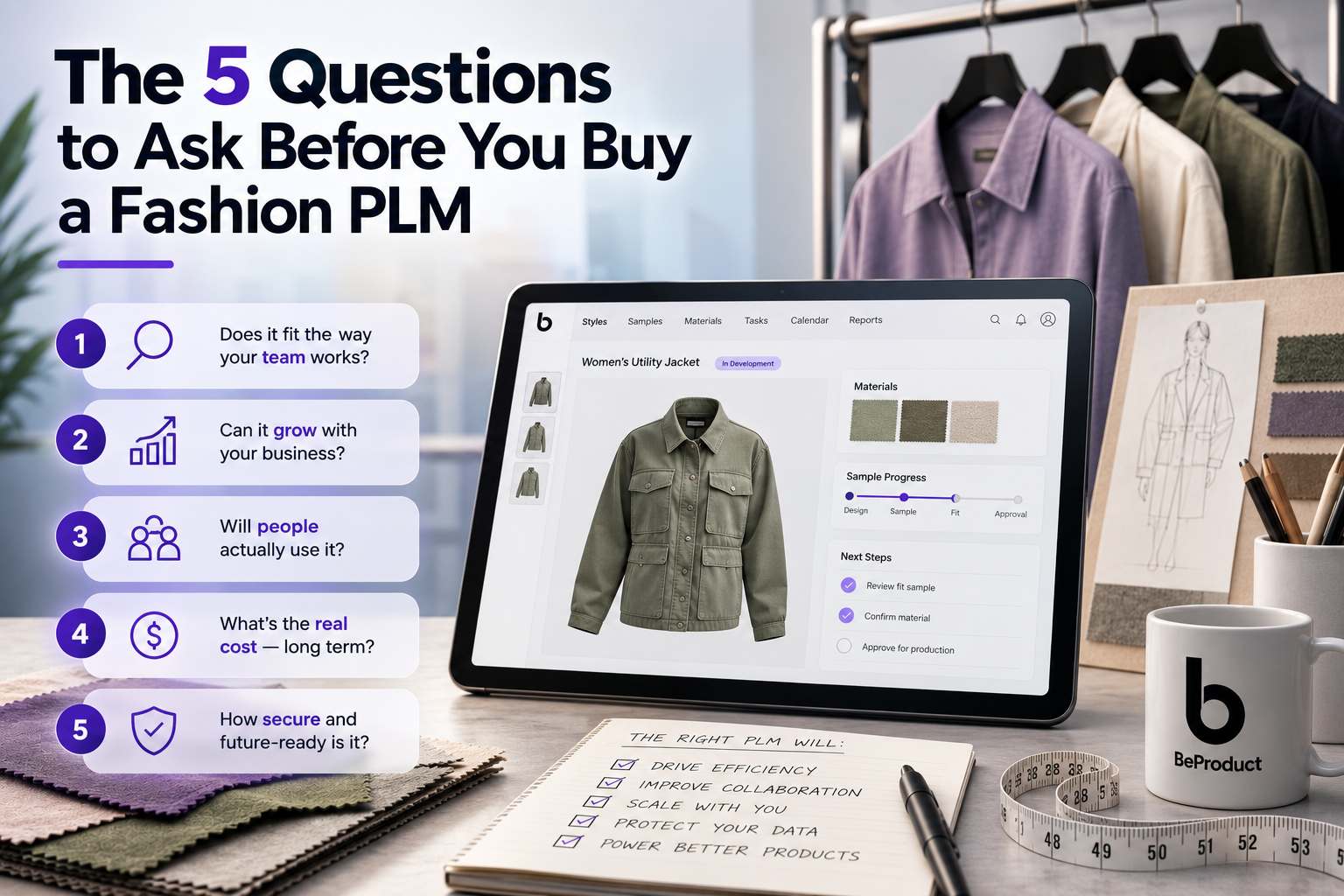
A fair buyer’s guide. The five questions that separate a PLM your team actually uses from expensive shelfware, speed-to-live, honest pricing, supplier collaboration, designer adoption, and proof.
By BeProduct
Buying a fashion PLM is a high-stakes decision made, usually, by people doing it for the first time. The demos all look impressive, the feature lists all overlap, and the real differences, the ones that determine whether the platform becomes the backbone of your product team or an expensive thing nobody opens, are exactly the ones that don’t show up in a polished sales deck. So instead of a feature checklist, here are the five questions that actually predict whether a PLM will work for you. Ask them of every vendor, insist on specific answers, and the right choice gets a lot clearer.
A quick note on fairness: these questions aren’t a trap, and they’re not rhetorical. They’re the things genuinely worth knowing before you commit, the ones an honest vendor will answer plainly and a evasive one will dodge. The dodging is itself an answer.
How long until we’re actually live?
This is the question that exposes the biggest hidden cost in PLM, because implementation time is where total cost of ownership quietly balloons. Modern, cloud-native fashion platforms typically implement in roughly three to six months; heavy enterprise systems built for engineering can take a year or more, often requiring dedicated IT and consultants before they return a dollar.1 Ask for a specific timeline to going live with your data and your workflows, not a vague “it depends.” A platform that needs a year of services before it works can cost a multiple of its license before you see any value. Speed-to-live isn’t a nice-to-have; it’s a major line in the real cost.
“How long until we’re live?” isn’t a logistics question, it’s a cost question. A year of implementation can cost more than the license.
Are there per-supplier or per-seat surprises?
Pricing opacity is a sales tactic, and it’s where buyers get caught. Some platforms charge in ways that scale painfully as you grow, per supplier, per integration, per module, turning an affordable-looking entry price into a number that climbs every time you add a factory or a user. Ask for the full pricing structure in writing: what’s included, what costs extra, and what happens to the total as your team and supplier base grow. The cleanest answer is transparent, predictable per-user pricing with no penalty for collaboration. BeProduct, for example, publishes a flat rate of $75 per user, per month, with no upfront infrastructure cost, the kind of transparency that’s rare enough to be a useful benchmark for the whole category.2
Will designers actually use it, or fight it?
This is the question that decides whether you get any return at all, and it’s the one feature lists can’t answer. A PLM only delivers value if the people who feed it data, designers and developers, actually use it. Software built for engineering or finance, with a data model and vocabulary foreign to a fashion team, gets resisted, worked around, and under-used, which means you pay for capability you never realize. Ask: is this built for how a designer and developer actually work? Does it speak tech pack, linesheet, BOM, sample round? Can a designer pick it up without a training department? Adoption is the hinge on which the entire investment turns, a platform your team fights is worse than the spreadsheet it replaced.
How does it handle suppliers and spec changes?
Supplier collaboration is where many platforms quietly fall short, and it’s the source of one of the most common product-development failures: a spec changed and the factory never got it. Ask specifically how the platform handles supplier communication and spec changes. Do suppliers work from the same record as the brand, or get forwarded files? Are the right people notified automatically when a spec changes, on the document they build from? A platform where changes propagate to a shared record and notify suppliers automatically prevents the missed-change, wrong-sample cycle that email and spreadsheets guarantee, a gap users of weaker tools complain about constantly.
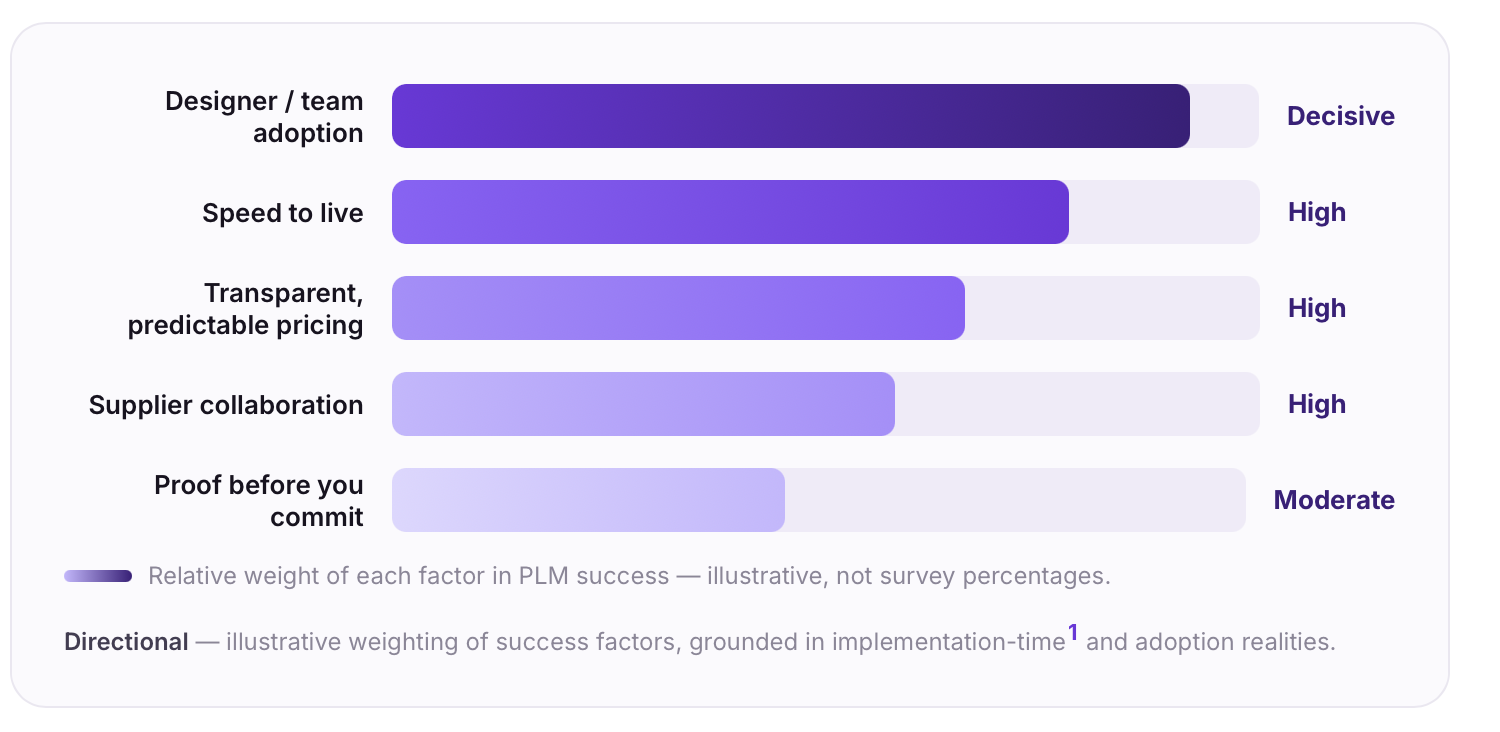
FIGURE 1
What actually predicts PLM success
The factors that most determine whether a PLM delivers value or becomes shelfware. Illustrative weighting, not survey data.
Can we prove it works before we commit?
The best protection against a wrong decision is evidence, so ask whether you can validate the platform on your own product and workflow before signing a long contract. Can you run a proof-of-concept with your real styles, your real BOMs, your actual process, and see whether the team adopts it and the promised value appears? A vendor confident in their product welcomes this; one who pushes you straight to a multi-year commitment without letting you test on reality is telling you something. The PLM market’s strong growth, the fashion and apparel segment expanding at roughly 11–12% a year, means there are many options, which gives you the leverage to insist on proof before commitment.3
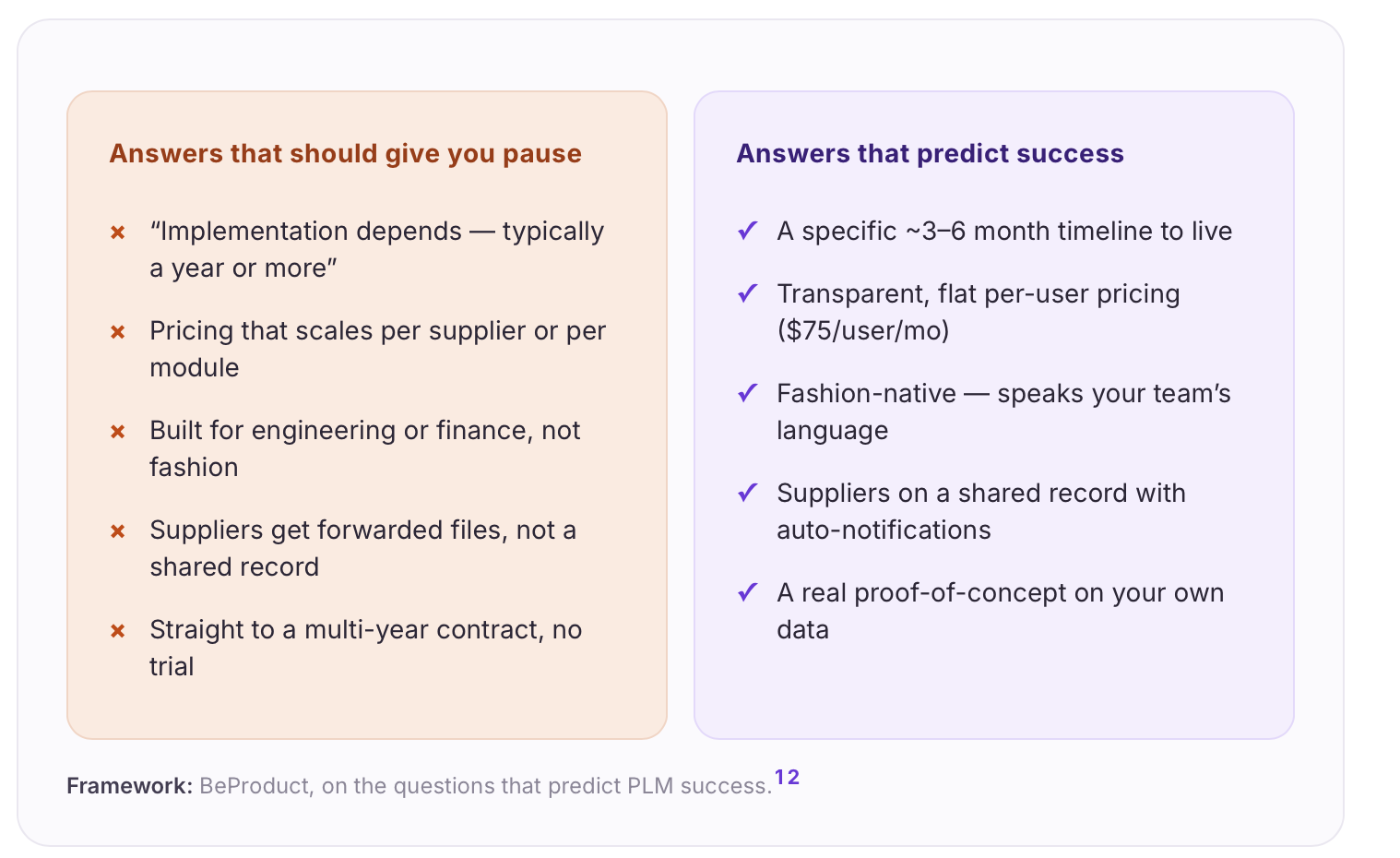
FIGURE 2
The answers that predict success vs. shelfware
What to listen for in each answer, and what should give you pause.

Buy for adoption, speed, and proof
A PLM purchase succeeds or fails on things the demo doesn’t show: how fast you’re live, whether the pricing stays sane as you grow, whether your designers actually use it, how it handles suppliers, and whether you could prove it works first. Ask those five questions of every vendor and weigh the answers honestly, not the feature lists, which mostly match. The right platform answers all five plainly, because it was built for a fashion team to adopt quickly, priced transparently, and confident enough to be tested on your reality. The wrong one dodges, and the dodge is the answer.
The buyer’s shortcut
If you only have time for one question, ask: “Can we run a real proof-of-concept on our own styles and workflow before we commit?” It folds in the others — because a vendor confident in adoption, speed, and value will say yes, and you’ll find out the truth about all five before you sign anything.
Add a sixth question for any serious evaluation: does it integrate with the 3D and DPC tools your team uses? The leading engines, CLO and Browzwear, are built to connect into fashion PLM, with Browzwear exporting assets straight into PLM and ERP, so a record that plugs into them keeps your design and 3D work in one flow. A platform that can’t connect to the tools your designers already run will fight adoption from day one.45
The takeaways
The demo hides the real differences feature lists match — the things that predict success don’t show up in them.
Ask the five questions time-to-live, pricing surprises, designer adoption, supplier handling, and proof before commitment.
Adoption is decisive a platform your team fights is worse than the spreadsheet it replaced.
Insist on proof a confident vendor lets you validate on your own data before a long contract.
REFERENCES
Style3D industry analyses (modern cloud fashion PLM implements in ~3–6 months versus a year or more for heavy enterprise rollouts). style3d.com
BeProduct, published pricing and positioning ($75 per user/month, no upfront infrastructure investment). go.beproduct.com
Univdatos Market Insights and Verified Market Research, fashion/apparel PLM software market (~11–12% CAGR). verifiedmarketresearch.com
CLO Virtual Fashion (CLO3D), a BeProduct 3D/DPC integration partner — product and ESG positioning (true-to-life virtual garment visualization; virtual sampling and remote collaboration shorten time-to-market; designing in virtual garments reduces sample production, shipment, and material waste). clo3d.com
Browzwear, a BeProduct 3D/DPC integration partner — company blog and product information (brands report up to 95% first-time-right samples and up to 80% fewer physical sampling rounds; late-stage design changes cost up to ~10× more than at concept stage; production-validated digital twins built on certified mill data; Fabric Analyzer measures physical fabric properties; assets export to PLM/ERP). browzwear.com/blog
Implementation timescales and pricing vary by vendor, scope, and brand. The success-factor chart is illustrative. Comparisons describe general category characteristics, not any single competing product.