
The Hidden Cost of Running Fashion on Spreadsheets
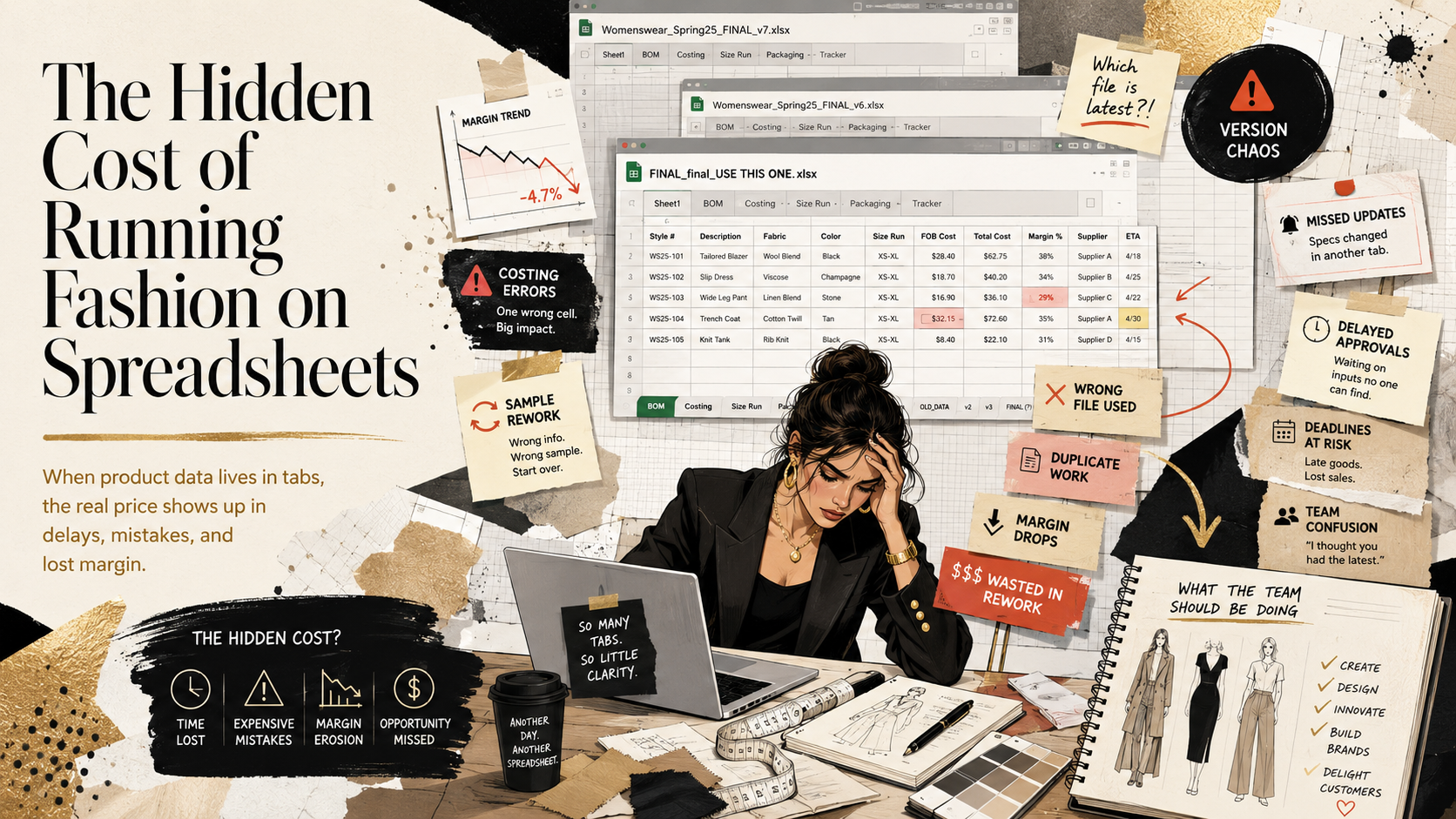
The spreadsheet has no license fee, so it gets treated as the “free” option. It isn’t free, it’s just a cost that never lands on an invoice. Here’s where it actually hides.
There’s a line item missing from almost every fashion brand’s budget, and it’s usually one of the largest. It’s the cost of the spreadsheet, not the software (that’s genuinely free), but everything the spreadsheet quietly causes: the re-keyed measurement that became a wrong sample, the colorway that didn’t propagate, the BOM that drifted out of sync, the week lost chasing a version nobody could find. None of it shows up on an invoice, so none of it gets counted. But it gets paid all the same.
This piece tries to make that invisible cost visible. We’ll walk through where it hides, attach real numbers where credible ones exist, and give you a simple way to size it for your own brand. The goal isn’t to shame the spreadsheet, it earned its place. It’s to count what it’s actually charging you.
Errors that become physical mistakes
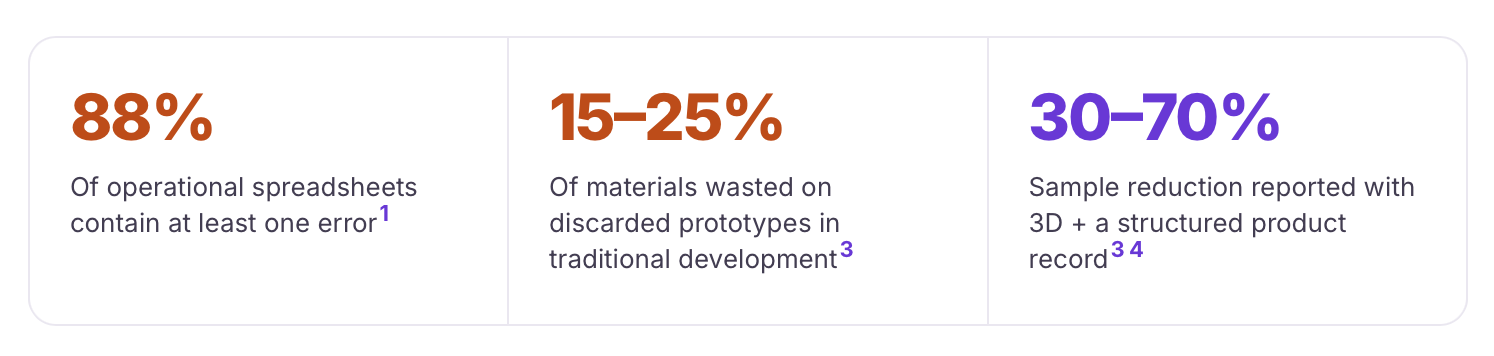
Start with the most measurable. Ray Panko’s long-running research at the University of Hawaii found that roughly 88% of operational spreadsheets contain at least one error, with an average cell error rate around 5%.1 In a finance model, a 5% error rate produces an awkward correction. In product development, that same rate is pointed directly at your tech packs, BOMs, and measurement specs, documents where a single wrong number doesn’t stay digital. It becomes a miscut garment, a wrong trim, a sample that has to be redone.
A spreadsheet that’s wrong 88% of the time isn’t a clerical nuisance in fashion. It’s a sample-generating machine, and samples cost real money.
Rework and the sample rounds it buys
Traditional development typically runs five to seven sample rounds to get from proto to production-ready. 2 Not all of those are necessary. A meaningful share exists only because information broke down somewhere, the factory built from a stale spec, a revision didn’t reach everyone, a comment got buried in a thread. Each avoidable round carries a sample cost, a shipping cost, and most expensively, a week or two of calendar you can’t buy back.
This is where the spreadsheet’s “free” price tag really unravels. When brands move that data into a structured system connected to 3D, reported reductions in physical samples land anywhere from roughly 30% to 70%, with sampling costs cut by up to about 70% in some accounts. 34 Whatever the exact figure for your category, the direction is consistent: a large slice of sampling spend is rework the data created, and better data removes it.
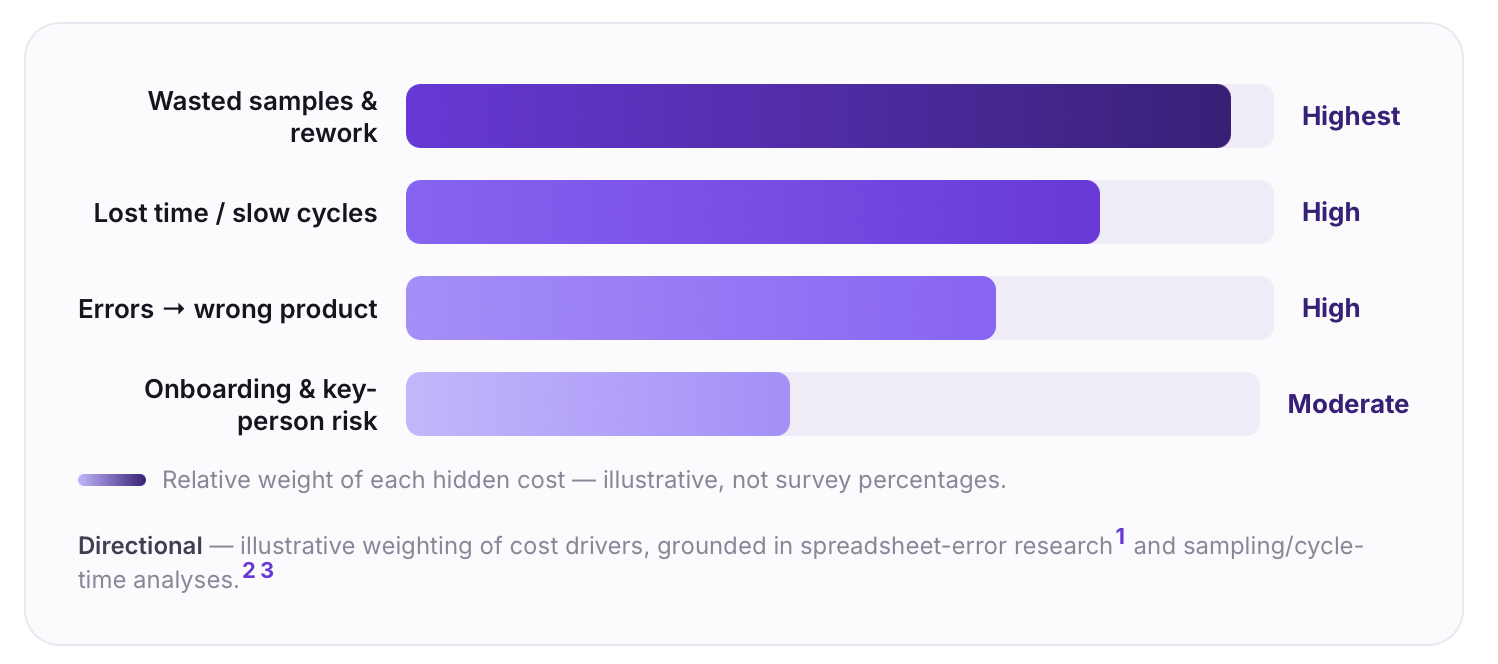
FIGURE 1
Where the “free” spreadsheet actually charges you
The recurring, uninvoiced costs of running product development on disconnected files. Bar lengths reflect the relative prominence of each cost driver, not a single survey figure.
Material waste you’re already absorbing
Physical samples aren’t just a line on a spreadsheet, they’re fabric, trims, labor, and freight. Industry analyses citing McKinsey put material waste from discarded prototypes in traditional development at roughly 15–25%.3 That waste is the spreadsheet’s cost expressed in physical goods: every extra round is fabric cut, sewn, shipped, and thrown away. Brands that connected product data to 3D have cut deep into it, Tommy Hilfiger reported around an 80% reduction in physical sample production after committing fully to 3D design, and Hugo Boss reported a 30%-plus sample reduction alongside roughly 85% faster design times.4
The weeks you can’t get back
The most expensive hidden cost doesn’t look like money at all, it looks like time. Traditional development cycles commonly run around 12 weeks, and PLM platforms are widely associated with cutting time-to-market by up to roughly 30%.3 For a brand on seasonal calendars, weeks aren’t a soft metric. They’re the difference between catching a trend and chasing it, between full-price sell-through and markdowns, between one more drop this season and one fewer. Every hour the team spends reconciling spreadsheets is an hour not spent on product, and some of those hours come straight out of the launch window.
A back-of-envelope you can run today
You don’t need a consultant to estimate your spreadsheet tax. Pick one avoidable cost — extra sample rounds, and do the arithmetic. The table below is deliberately conservative and illustrative; plug in your own numbers and the shape usually holds.
FIGURE 2
A simple way to size the spreadsheet tax
Illustrative only, not a quote. The point is the method: pick one avoidable cost, attach a credible unit price, and multiply by a season.
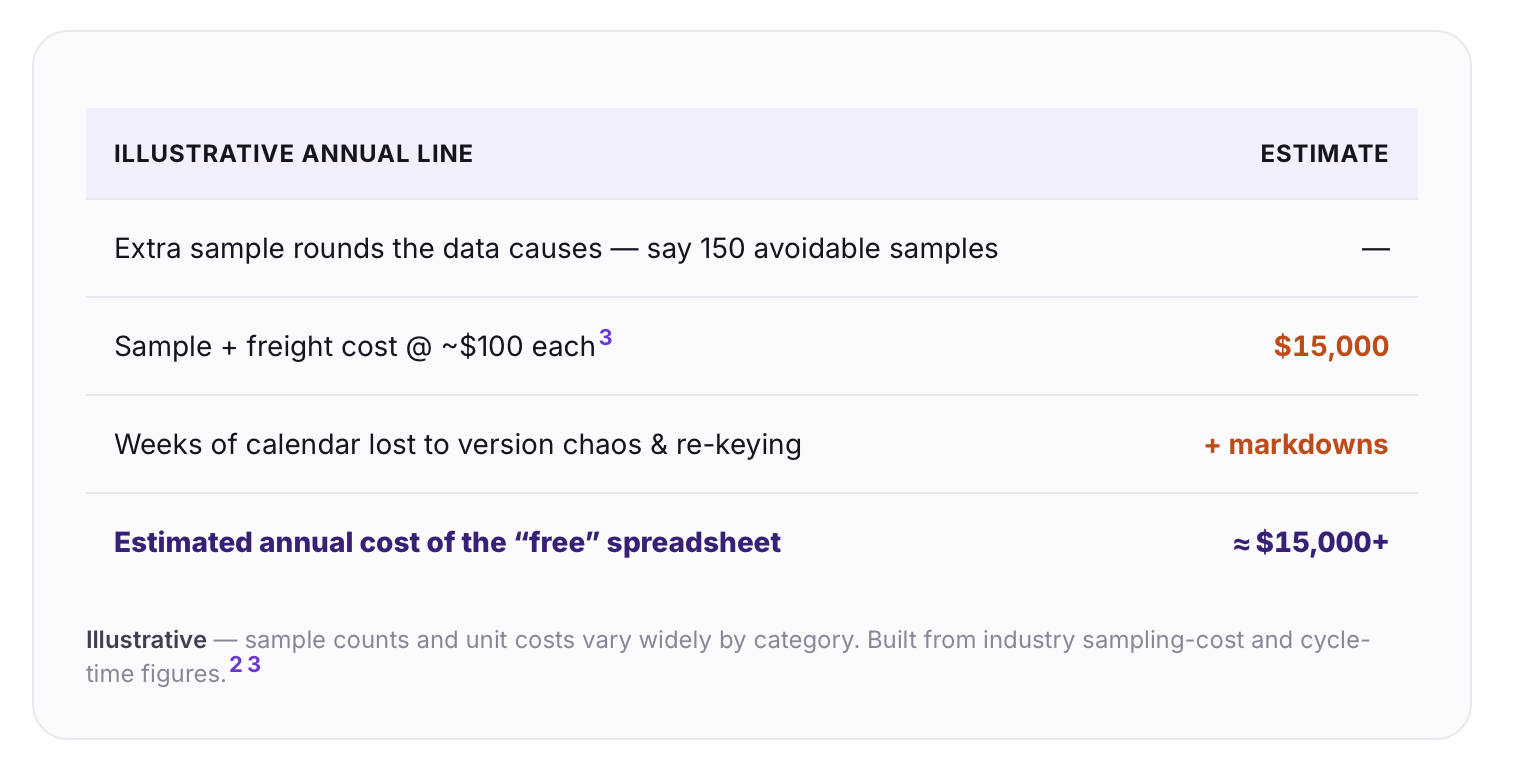
Set that against a transparent, modern PLM, BeProduct publishes a rate of $75 per user, per month, with no upfront infrastructure cost 5, and for most mid-market teams the math flips fast. Ten seats run $9,000 a year; the avoidable waste above already exceeds it, before you count the recovered weeks. The spreadsheet only looked cheaper because its bill was hidden.
The reframe
The real comparison was never “PLM versus free.” It was “the cost of a system versus the cost of the workarounds you’re already paying for.” Once the samples, the rework, the material waste, and the lost weeks are on the page, the spreadsheet stops looking like the budget option, and a structured product record starts looking like the conservative financial choice.
The cost of staying on spreadsheets also shows up as 3D value you can never capture. Browzwear reports brands cutting physical sampling by up to 80% and reaching up to 95% first-time-right samples, and CLO frames virtual garments as a direct way to reduce sample production, shipping, and material waste, but none of it runs on spreadsheet data. The workaround isn’t only costing you errors; it’s costing you the savings the modern toolchain was built to deliver.67
The takeaways
The cost is real, just uninvoiced spreadsheets are paid in errors, rework, waste, and lost weeks instead of a license fee.
Errors become physical mistakes ~88% of spreadsheets contain errors, and in a BOM that’s a wrong sample.
Waste is measurable 15–25% of materials lost to discarded prototypes; 3D + structured data cuts samples 30–70%.
Run the math yourself one avoidable cost times a season usually exceeds a $75/user/month subscription, before counting recovered time.
REFERENCES
R. Panko, University of Hawaii, “What We Know About Spreadsheet Errors” (~88% of operational spreadsheets contain errors; ~5% average cell error rate). panko.shidler.hawaii.edu
Apex Fashion Lab, product development guide (typically 5–7 sample rounds; 3D digital sampling reduces physical samples ~50% and sampling costs up to ~70%). apexfashionlab.com
Style3D industry analyses (traditional methods waste ~15–25% of materials, citing McKinsey; 3D digital sampling reduces physical samples ~30–50%; time-to-market reduced up to ~30%; ~12-week cycles). style3d.com
StyTrix, “Digital Sampling in Fashion” (Tommy Hilfiger ~80% reduction in physical sample production; Hugo Boss ~85% design-time improvement and 30%+ sample reduction; Adidas 1M+ material samples saved). stytrix.com
BeProduct, published pricing and positioning ($75 per user/month, no upfront infrastructure investment). go.beproduct.com
CLO Virtual Fashion (CLO3D), a BeProduct 3D/DPC integration partner — product and ESG positioning (true-to-life virtual garment visualization; virtual sampling and remote collaboration shorten time-to-market; designing in virtual garments reduces sample production, shipment, and material waste). clo3d.com
Browzwear, a BeProduct 3D/DPC integration partner — company blog and product information (brands report up to 95% first-time-right samples and up to 80% fewer physical sampling rounds; late-stage design changes cost up to ~10× more than at concept stage; production-validated digital twins built on certified mill data; Fabric Analyzer measures physical fabric properties; assets export to PLM/ERP). browzwear.com/blog
ROI, sample-reduction, material-waste, and time-to-market figures are brand- and vendor-reported and vary by product, workflow, and category. The sizing table is an illustrative example, not a quote or guarantee.