
The Operational Iceberg: The Problems Fashion Companies Don’t Talk About
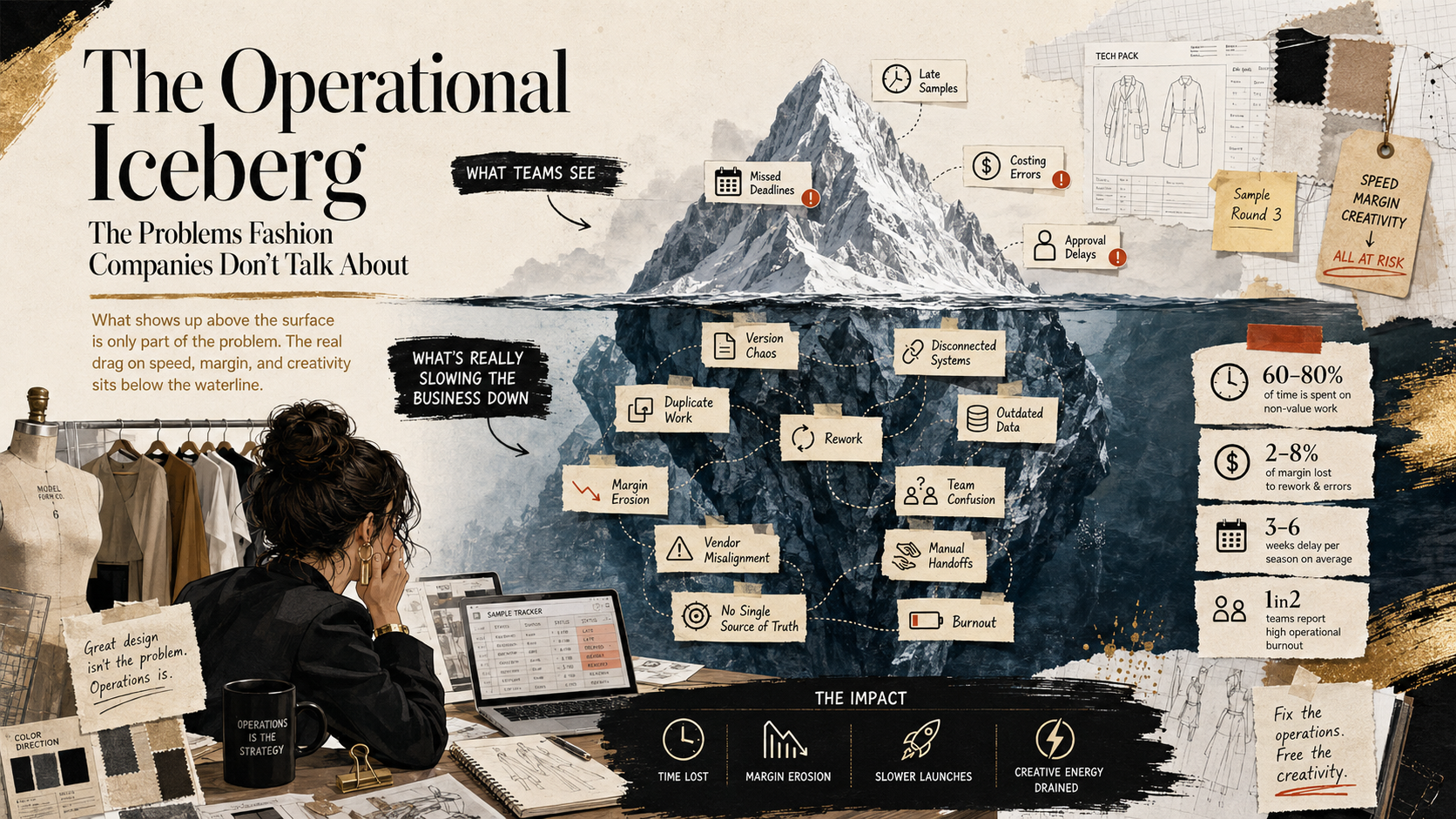
Every brand shows the world a polished surface: the campaign, the collection, the story. Below the waterline sits an operation most companies won’t discuss, fragmented data, version confusion, endless sample rounds, quiet margin leaks. These are the problems fashion truly faces, and 2026 is the year they stop being survivable.
There’s the fashion brand the world sees, the campaign imagery, the runway, the perfectly merchandised store, and then there’s the operation that produces it, which almost nobody talks about. Below the polished surface, in company after company, sits the same iceberg: product data scattered across a hundred spreadsheets, nobody quite sure which version of the tech pack is current, sample rounds dragging on far longer than anyone admits, suppliers working from outdated specs, costs that surprise everyone at the worst moment, and critical knowledge living in one veteran employee’s head. It’s the unglamorous machinery of getting product made, and it’s held together with heroics and habit. Brands don’t put this in the investor deck or the press release. But it’s the truth of how most fashion companies actually run, and in 2026, the part below the waterline is where the business is quietly won or lost.
This piece is about naming the things fashion doesn’t name. Not the strategy-deck challenges everyone discusses, but the operational dysfunction everyone lives with and nobody quite owns, because until you name it, you can’t fix it, and 2026 has made fixing it urgent.
The problems that never make the deck
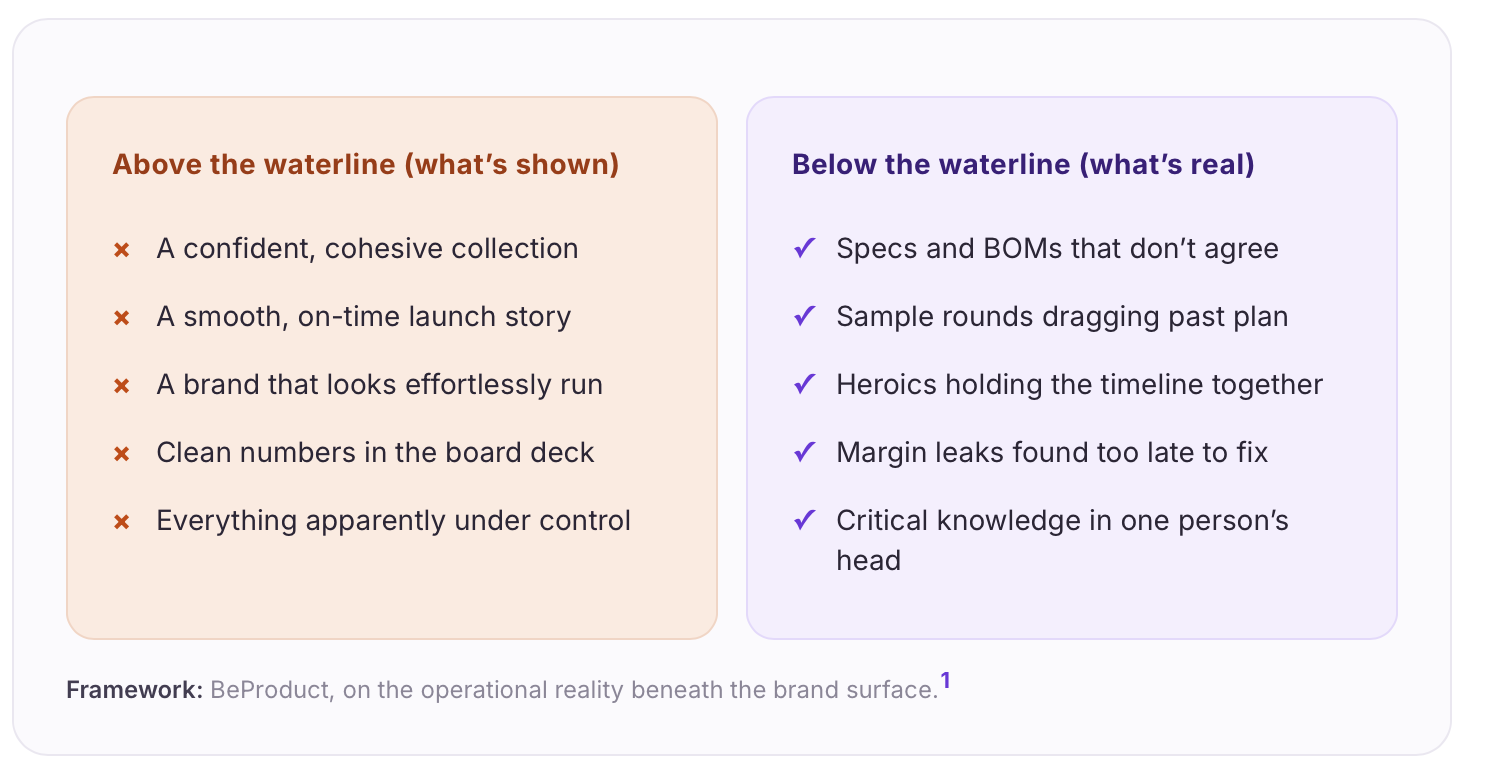
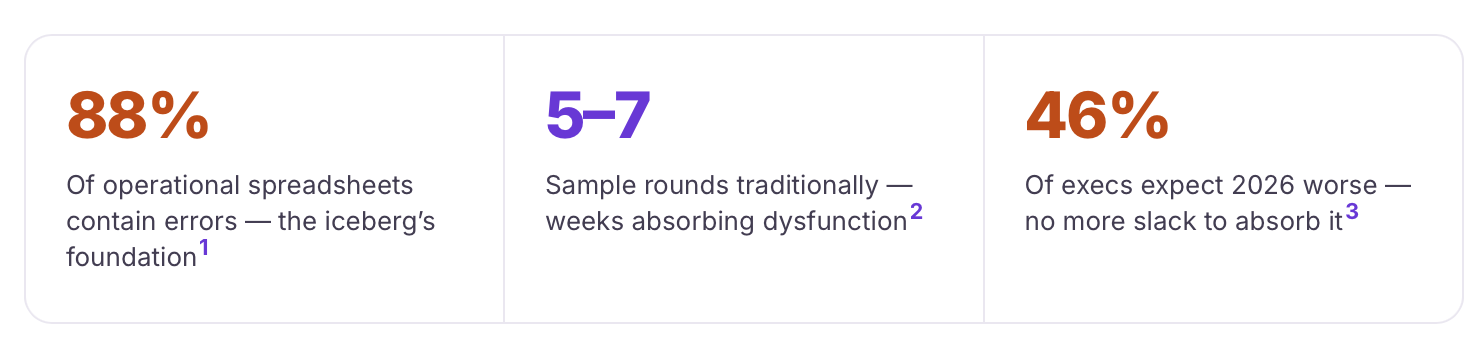
Ask people privately what actually slows their brand down and the same answers surface every time. Product data is fragmented, specs, BOMs, costs, and materials live in separate files that don’t agree with each other. Version control is a daily hazard; “which one is final?” is a question asked dozens of times a week. Feedback scatters across email and chat and gets lost. Suppliers build from specs that changed after they received them. Costing is a guess until it’s suddenly a problem. And institutional knowledge is tribal, when the right person is out or leaves, things break. None of these is dramatic on its own. Collectively, they’re the real operating system of the brand, and with roughly 88% of operational spreadsheets containing at least one error, the foundation that system runs on is quietly unreliable.1
These problems aren’t dramatic on their own. Collectively, they’re the real operating system of the brand and nobody owns them.
FIGURE 1
What the brand shows vs. what the operation feels
The gap between the polished surface and the machinery underneath, the part nobody puts on a slide.
Why nobody talks about it
If these problems are so universal, why does no one name them? Several reasons, and they reinforce each other. First, it’s unglamorous, fashion celebrates creativity and brand, not BOM hygiene, so operational dysfunction has no champion and no spotlight. Second, it feels normal; people who’ve only ever worked this way assume the chaos is simply what fashion is, an inherent cost of the business rather than a fixable problem. Third, and most importantly, no single team owns it. The pain lives in the seams between functions, between design and development, development and sourcing, sourcing and production, so each team sees only their slice and assumes the rest is fine. The dysfunction is everywhere, which paradoxically means it’s nobody’s job to fix. That’s how a problem this large stays this invisible.
Death by a thousand small inefficiencies
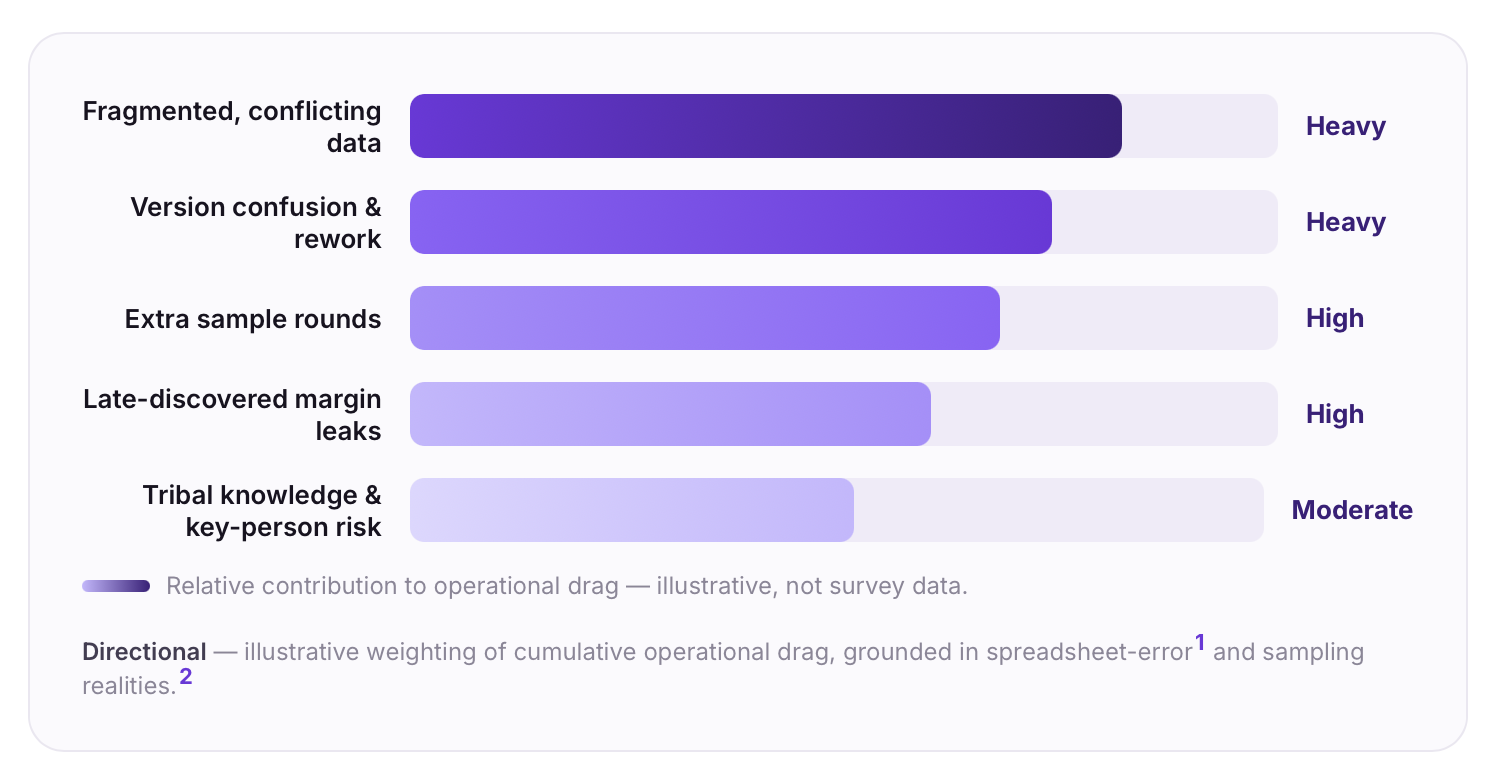
Here’s why the iceberg matters even though no single piece of it looks fatal. The cost is cumulative. Each fragmented file, each version mix-up, each extra sample round, each margin leak is individually small and individually survivable, which is exactly why it survives. But they sum. The drag they create together is what quietly caps how fast a brand can move, how lean it can run, and how much margin it keeps. A traditional process runs five to seven sample rounds partly because of these compounding errors and miscommunications; that’s weeks of calendar and real money spent absorbing dysfunction rather than creating value.2 The brand never sees a single catastrophic failure to point at. It just runs slower and thinner than it should, forever, and calls it normal.
FIGURE 2
The cumulative drag of the iceberg
No single problem is fatal — but stacked together, the unspoken inefficiencies create the drag that caps speed and margin. Illustrative weighting.
Why 2026 makes the iceberg existential
Brands have absorbed this operational drag for decades, so why does it suddenly matter? Because the slack that let them absorb it is gone. In 2026, tariffs have pushed average US apparel duties to around 35%, attacking margin from the outside, while McKinsey and BoF found 46% of executives expecting conditions to worsen against only low-single-digit projected growth.3 When margins were comfortable and growth was easy, you could afford to leak a few points to operational chaos and not feel it. You can’t anymore. Every point of margin lost to the iceberg is a point you can’t spare when tariffs are taking their share too — which is precisely why McKinsey points to digitised sourcing, better forecasting, and operational efficiency as core levers for the year.3 The dysfunction that was an annoyance in good times becomes a threat in hard ones. 2026 is the year the iceberg stops being survivable.
You can’t fix what you can’t see — so make it visible
The reason the iceberg persists is that it’s invisible and unowned. So the fix starts by making it visible and giving it a home: a single connected product record where the data, specs, BOMs, costs, materials, feedback, and version history all live together. The moment they do, the iceberg surfaces, you can see the fragmented data because it’s now in one place, eliminate version confusion because there’s one current version, stop suppliers building from stale specs because they pull from the live record, catch margin leaks because costing is visible during development, and capture tribal knowledge because the process lives in the system instead of someone’s head. Connecting the operation doesn’t just speed things up; it drags the hidden dysfunction into the light where it can finally be fixed.
The digital-product-creation toolchain attacks the most expensive piece of the iceberg directly. Endless sample rounds, one of the biggest hidden cost, collapse when development moves to accurate 3D: Browzwear reports up to 80% fewer physical samples and up to 95% first-time-right, and CLO’s virtual sampling cuts the rounds, the shipping, and the waiting.45 Connected to the record, that’s a large slice of the iceberg melted — and the savings show up exactly where 2026 needs them.
Name it, surface it, fix it
The problems fashion companies truly face aren’t the ones in the strategy deck — they’re the ones below the waterline that nobody names: fragmented data, version chaos, sample drag, margin leaks, tribal knowledge. They’ve been tolerated for decades because each is small, none is fatal, and no single team owns them. But they sum into a permanent drag on speed and margin, and in a year when tariffs and slow growth have removed the slack that hid them, that drag has become a genuine threat. The brands that thrive in 2026 will be the ones willing to name the iceberg, surface it by connecting their operation on a single record, and finally fix what everyone else is still pretending is just normal.
The honest test
Ask your team privately what actually slows them down, not the strategic challenges, the daily operational ones. You’ll hear about the iceberg: the conflicting files, the version hunts, the stale specs, the surprise costs. Those are the problems fashion doesn’t talk about, and in 2026 they’re the ones that matter most. You can’t fix what you can’t see. Connect the operation, make the iceberg visible, and start melting it.
The takeaways
The real problems are below the waterline fragmented data, version chaos, sample drag, margin leaks, tribal knowledge — not the strategy-deck challenges.
Nobody names them for a reason they’re unglamorous, they feel normal, and no single team owns the pain in the seams.
The cost is cumulative, not catastrophic each problem is small and survivable, but together they permanently cap speed and margin.
2026 removed the slack that hid them with tariffs squeezing margin and growth slow, the iceberg becomes existential — surface it and fix it.

REFERENCES
R. Panko, University of Hawaii, “What We Know About Spreadsheet Errors” (~88% of operational spreadsheets contain at least one error; ~5% average cell error rate). panko.shidler.hawaii.edu
Apex Fashion Lab, product development guide (typically 5–7 sample rounds from proto to production-ready; each round adds calendar time and cost). apexfashionlab.com
McKinsey & Company and BoF Insights, “The State of Fashion 2026” (46% of execs expect conditions to worsen, up from 39%; low-single-digit growth; tariffs the dominant factor; digitised sourcing, forecasting, and operational efficiency as core 2026 levers). mckinsey.com
Browzwear, a BeProduct 3D/DPC integration partner (up to 80% fewer physical samples; up to 95% first-time-right; assets export to PLM/ERP). browzwear.com/blog
CLO Virtual Fashion (CLO3D), a BeProduct 3D/DPC integration partner (virtual sampling reduces sample rounds, shipping, and material waste). clo3d.com
The drag and cumulative-cost charts are illustrative, grounded in spreadsheet-error and sampling research; they are not single survey results. Macro figures are third-party reported (McKinsey & BoF). CLO and Browzwear are BeProduct partners; their figures are vendor-reported.