
The Real Cost of Version Chaos in Product Development
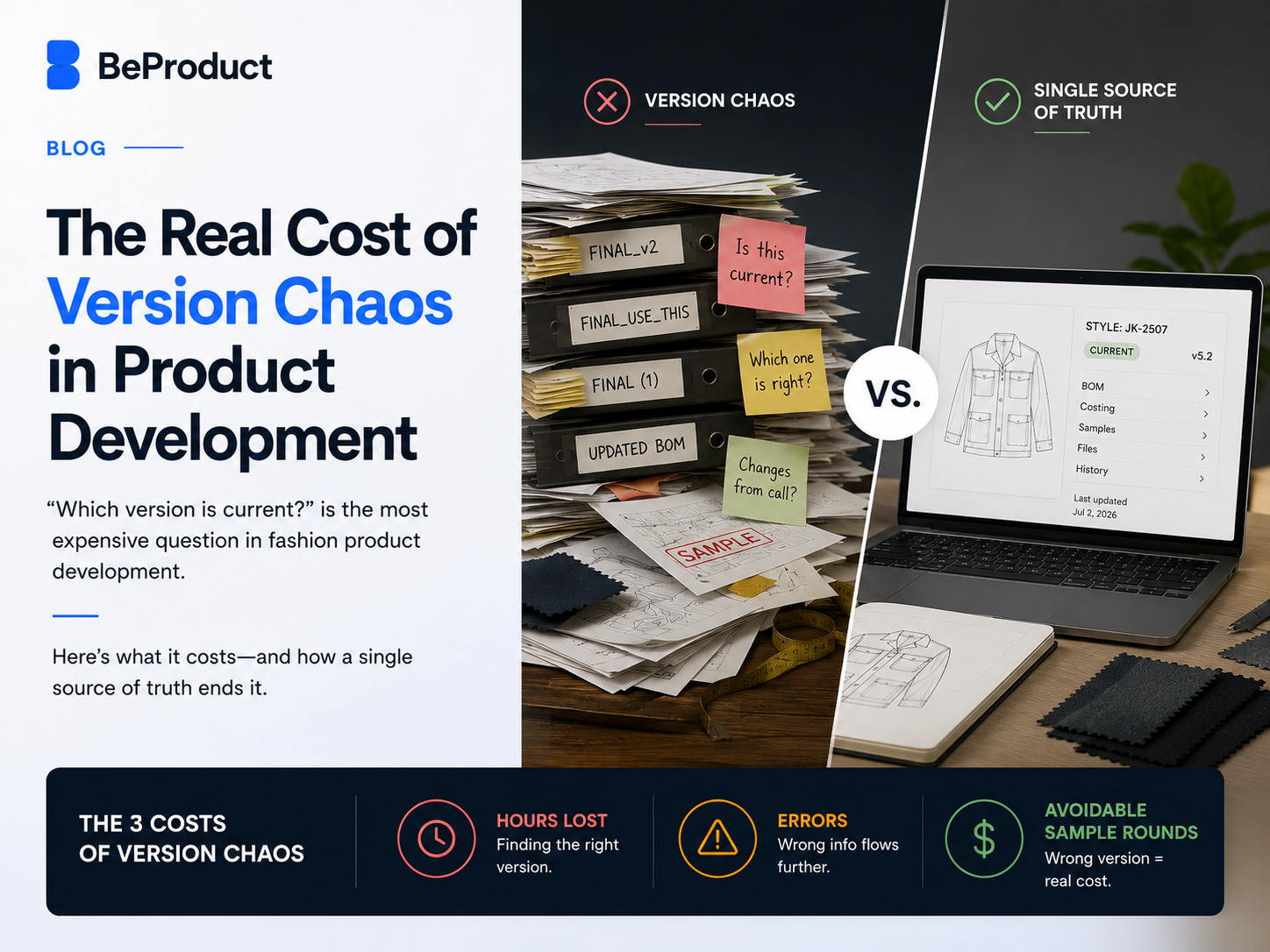
“Which version is current?” is the most expensive question in fashion product development. Here’s what version chaos actually costs, and how a single source of truth ends it.
Final. Final_v2. Final_USE_THIS. Every fashion product team knows the file names, and every one of them is laughing nervously, because the joke is also the problem. Version chaos, the state where multiple copies of the same product information exist and nobody is fully sure which one is right, is so normal that it stops looking like a cost. It just looks like work. But it is a cost, and once you trace it through to physical samples and lost weeks, it’s one of the largest line items hiding in your development budget.
Let’s make it concrete. Here’s exactly how version chaos charges you, in three distinct ways, and why the only real fix is structural rather than disciplinary.
The hours spent answering “which one is current?”
Start with the most direct cost: time. Every time a developer, a designer, or a sourcing manager has to stop and figure out which version is authoritative, the work pauses. Multiply that across a team, across every style, across a season, and it’s not minutes, it’s weeks of senior people doing detective work instead of product work. And the detective work produces nothing. It’s pure overhead created entirely by the absence of a single source of truth.
Every minute spent answering “which version is current?” is a minute the work is paused, and the answer produces nothing but a chance to be wrong.
The errors that propagate from the wrong copy
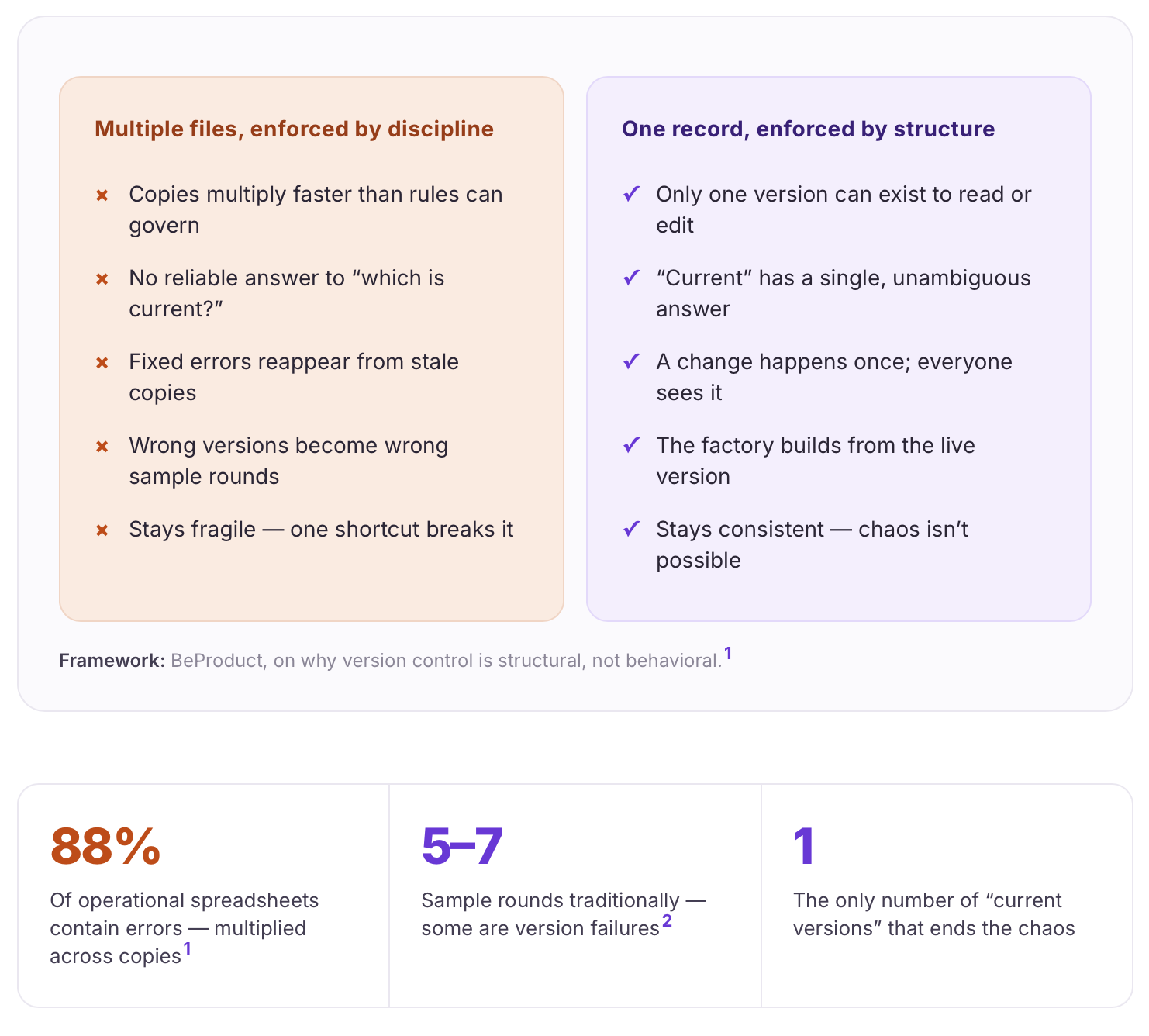
Worse than the time is the error. When someone works from a stale version, an old measurement, a superseded BOM, a colorway that changed, the mistake doesn’t stay contained. It flows downstream into the spec, the cost, the factory order. With roughly 88% of operational spreadsheets already containing at least one error, version chaos multiplies the exposure: now you don’t just have errors, you have errors in some copies and not others, and no reliable way to know which.1 The wrong version is how a fixed mistake comes back to life.
The sample rounds the wrong version buys
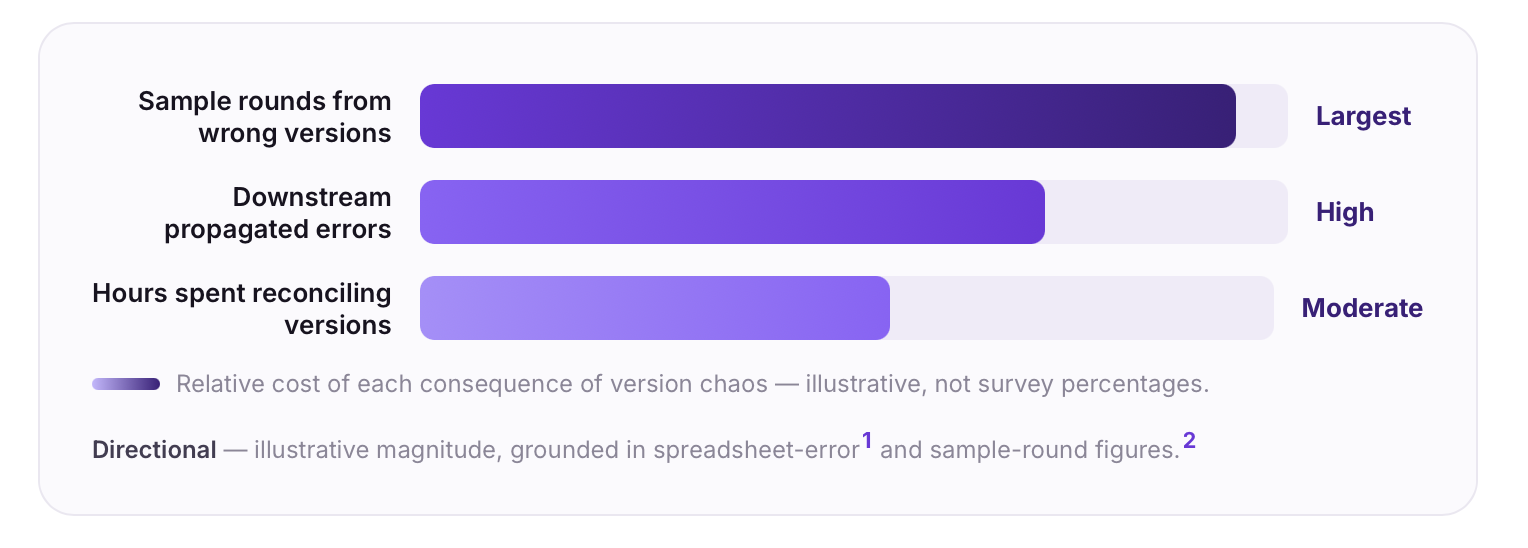
This is where version chaos stops being an annoyance and starts being a budget item. When the factory builds from a version that isn’t current, the sample comes back wrong — and a wrong sample is a wrong sample round, with all its costs: the sample itself, freight both ways, and the weeks waiting for it. Traditional development already runs five to seven rounds; a meaningful share of the extra rounds are version failures the team paid a factory to physically reproduce.2 This single cost often dwarfs the other two combined.
FIGURE 1
The three costs of version chaos
How the absence of a single source of truth charges a product team. Bar lengths reflect relative cost magnitude, not exact figures.
The problem is structural
The instinctive response to version chaos is a process rule: stricter file naming, a shared folder convention, a “single master file” everyone promises to use. These help a little and fail predictably, because they fight human nature with willpower. Someone will save a local copy to work faster. Someone will email a version to a supplier. Someone will be offline and branch. As long as the product information can exist as multiple independent copies, chaos is the default state and discipline is a tax you pay to hold it off temporarily.
The only durable fix is to remove the possibility of conflicting copies, to make there be one record, with one current version, that everyone reads from and writes to. That’s not a convention; it’s an architecture. When a change happens once and everyone sees it, there is no “which version,” because there’s only one. The question that ate your weeks simply stops having more than one answer.
FIGURE 1
Version chaos vs. a single source of truth
Why a convention can’t solve what an architecture can.
A single source of truth pays for itself
Version chaos feels free because, like the spreadsheet itself, its cost never lands on an invoice — it’s paid in reconciliation hours, propagated errors, and avoidable sample rounds. Put those on the page and the case for a single structured product record makes itself: it’s not an IT nicety, it’s the elimination of one of the most expensive recurring costs in development. A fashion PLM provides exactly that — one record, one current version, full history — and in doing so retires “which one is current?” for good.
The reframe
You can’t discipline your way out of version chaos, because the problem isn’t that people are careless, it’s that the system allows conflicting copies to exist at all. Remove that possibility with a single source of truth, and the most expensive question in product development stops being a question.
This is why the 3D leaders insist on a single connected asset. Browzwear has approved digital twins move directly into production workflows without manual re-entry, and CLO’s connected design hub keeps one authoritative virtual garment rather than scattered copies. When the 3D model, the spec, and the cost share one record, “which version?” has the same single answer for the digital sample as for everything else.34
The takeaways
Version chaos charges you three ways reconciliation hours, propagated errors, and avoidable sample rounds.
The sample-round cost dominates a wrong-version sample is a full sample round you paid to reproduce a mistake.
Discipline can’t fix it as long as conflicting copies can exist, chaos is the default and rules are a temporary tax.
One record ends the question a single source of truth makes “current” unambiguous — that’s what PLM provides.
REFERENCES
R. Panko, University of Hawaii, “What We Know About Spreadsheet Errors” (~88% of operational spreadsheets contain errors; ~5% average cell error rate). panko.shidler.hawaii.edu
Apex Fashion Lab, product development guide (typically 5–7 sample rounds from proto to production-ready). apexfashionlab.com
CLO Virtual Fashion (CLO3D), a BeProduct 3D/DPC integration partner — product and ESG positioning (true-to-life virtual garment visualization; virtual sampling and remote collaboration shorten time-to-market; designing in virtual garments reduces sample production, shipment, and material waste). clo3d.com
Browzwear, a BeProduct 3D/DPC integration partner — company blog and product information (brands report up to 95% first-time-right samples and up to 80% fewer physical sampling rounds; late-stage design changes cost up to ~10× more than at concept stage; production-validated digital twins built on certified mill data; Fabric Analyzer measures physical fabric properties; assets export to PLM/ERP). browzwear.com/blog
Cost-magnitude figures are illustrative, grounded in spreadsheet-error research and industry sample-round counts; they are not a single survey result.