
Why Most Fashion AI Projects Stall, and the Backbone That Fixes Them
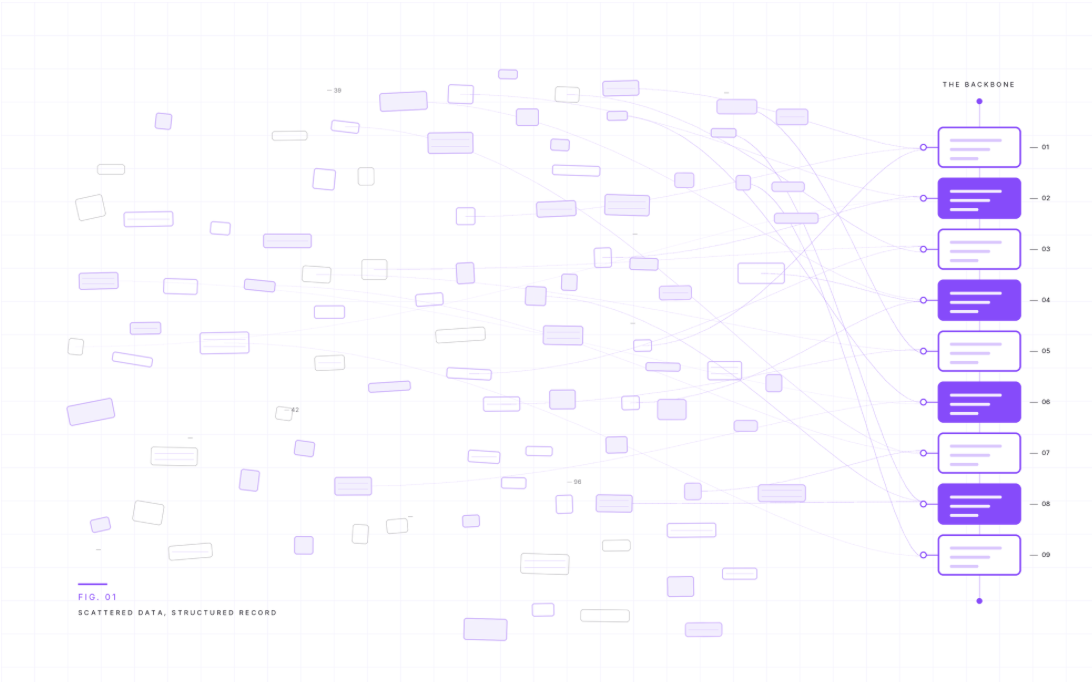
Nearly nine in ten companies now use AI. Only about a third have scaled it. The difference is rarely the model, it’s the data underneath. Here’s what that means for fashion.
There’s a strange contradiction running through fashion right now. Walk any trade show floor in 2026 and AI is on every banner, generated imagery, trend prediction, automated tech packs, virtual fitting. Yet ask brands what measurable value those tools have delivered, and the honest answers get quiet fast. A pilot here. A demo there. A proof-of-concept that impressed everyone and then never shipped. The technology works. The transformation doesn’t arrive.
This isn’t a fashion problem. It’s the defining story of enterprise AI, and the data behind it is unusually clear. The reason most AI initiatives stall has very little to do with the intelligence of the model, and almost everything to do with the state of the data you point it at. For fashion brands, that distinction is the whole game.
Everyone’s using AI. Almost no one has scaled it.
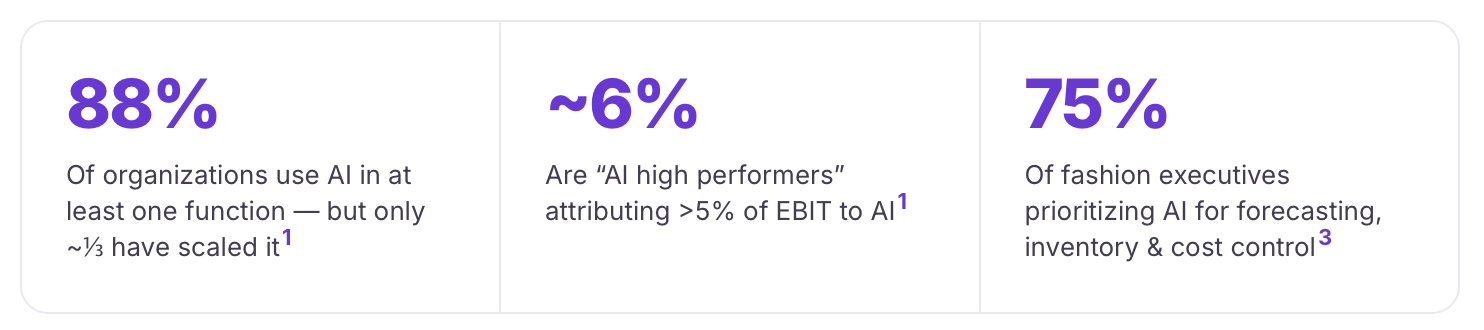
McKinsey’s 2025 global survey on the state of AI found that 88% of organizations now use AI in at least one business function, up from 78% a year earlier. Adoption, in other words, is essentially universal. But at the enterprise level, the majority are still stuck in experimentation and piloting, with only about one-third reporting they’ve begun to scaleAI across the organization.1 And the group seeing real financial impact is smaller still: McKinsey classifies just about 6% as “AI high performers,” organizations attributing more than 5% of their EBIT to AI.1
FIGURE 1
The AI value funnel: from universal adoption to rare impact
Share of organizations at each stage. Adoption is near-universal; scaled, EBIT-moving impact is the exception.
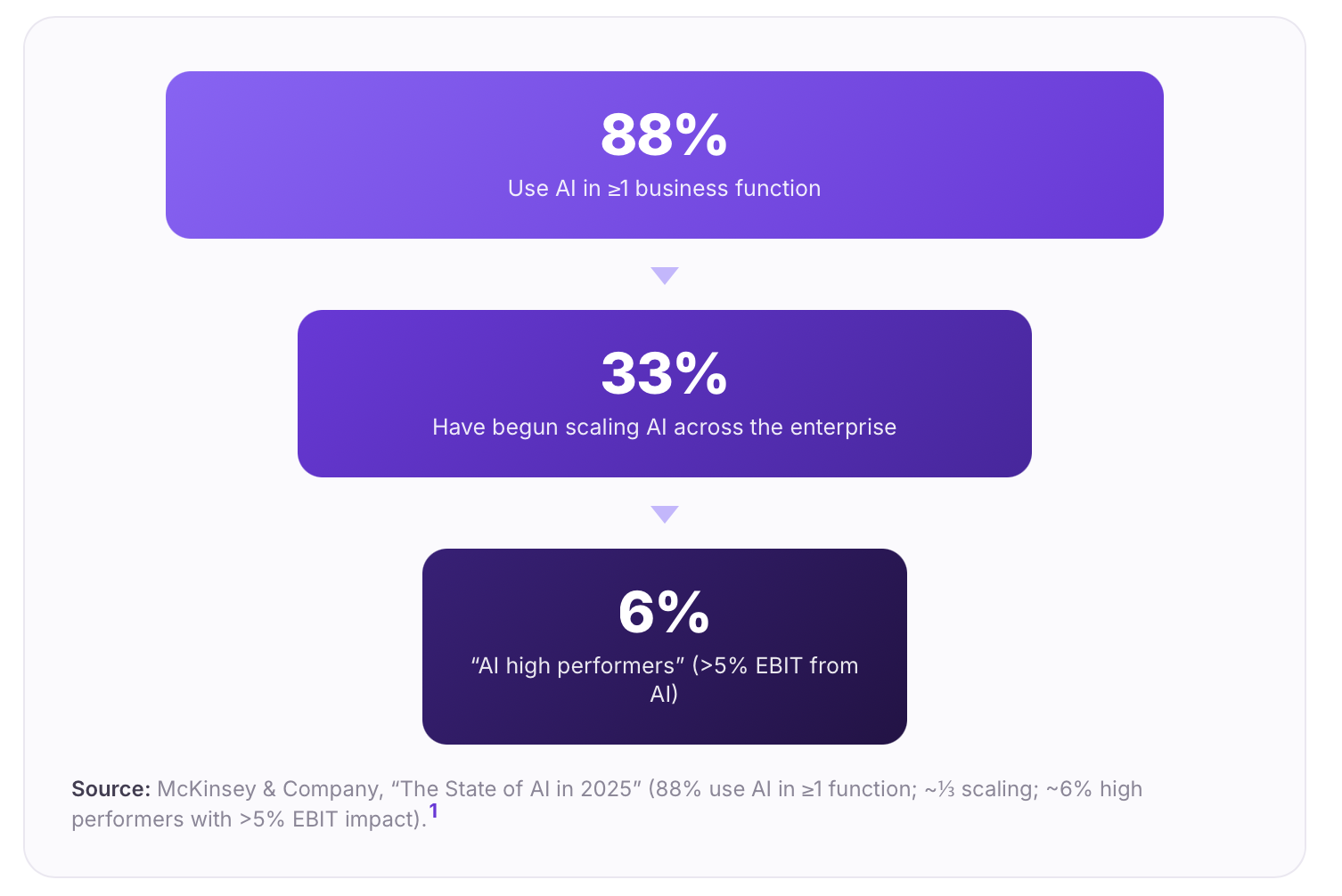
That shape, a wide top and a needle-thin bottom, is what practitioners now call “pilot purgatory.” Companies can fund pilots indefinitely and still never change how work actually gets done. The bottleneck isn’t access to AI. It’s the ability to operationalize it.
The blockers are remarkably consistent
When McKinsey looked at why organizations can’t cross from pilot to scale, the blockers were the same across industries and company sizes. At the very top of the list sits the one fashion brands should pay closest attention to.
FIGURE 2
What keeps AI stuck in the pilot stage
The recurring blockers to scaling AI. Bars reflect the relative prominence of each theme in the analysis, with data quality and architecture cited first.
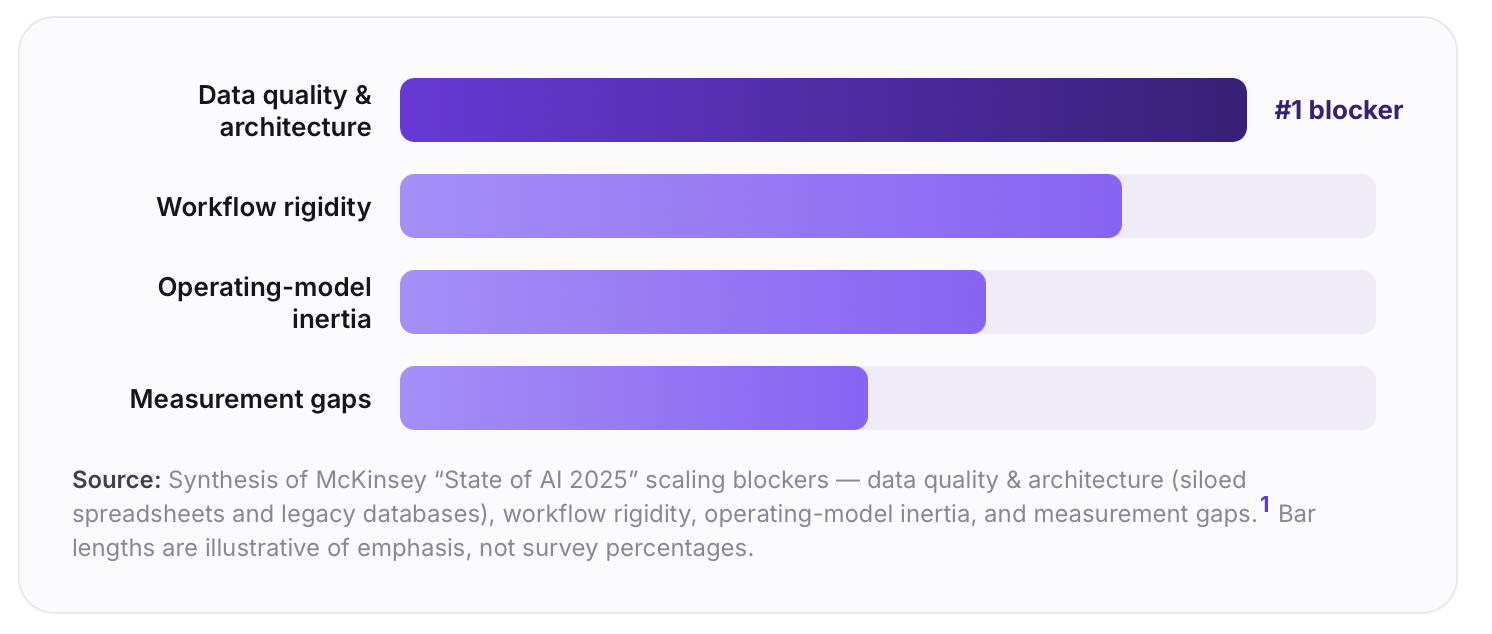
Read the language McKinsey uses for the top blocker carefully, because it’s almost a description of a typical fashion product-development stack: scaling AI requires clean, integrated, well-governed data, not the siloed spreadsheets and legacy databases most organizations actually run on.1 If your product data lives across a hundred workbooks, a dozen email threads, and three shared drives, there is nothing for an AI system to reliably learn from, act on, or automate.
You can’t bolt intelligence onto chaos. AI doesn’t fail in fashion because the models are weak, it fails because the product data has no spine.
High ambition, messy data
Fashion executives are not short on AI ambition. In McKinsey’s State of Fashion research, 75% of fashion executives said they were prioritizing AI for demand forecasting, inventory optimization, and cost control, and 45% pointed to AI-driven marketing as a major value driver.3 By 2026, more than a third of fashion and luxury players reported already using generative AI in functions like customer service, image creation, copywriting, and product discovery.2
But fashion’s data is uniquely difficult. A single style carries a sketch, a spec, a bill of materials, a color and material library, a size run, supplier comments, costing, sample statuses, and revision history, and in most mid-market brands, those live in different files, owned by different people, updated on different days. McKinsey’s own guidance to the industry is pointed: leaders need to shift away from small pilots that deliver only incremental change toward a more fundamental reassessment of how their organizations actually work.2 Translated for product teams, that means fixing the data foundation before expecting AI to deliver.
AI needs a backbone — and PLM is it
Here is the reframe that changes the conversation. The question isn’t “which AI tool should we buy?” It’s “is our product data structured enough for any AI tool to be worth buying?” A Product Lifecycle Management platform is, at its core, the system that turns scattered product information into a single, structured, connected record. That record is the backbone AI requires, the difference between a model guessing and a model knowing.
FIGURE 3
The same AI ambition, two data foundations
What AI can realistically deliver depends almost entirely on what sits beneath it.
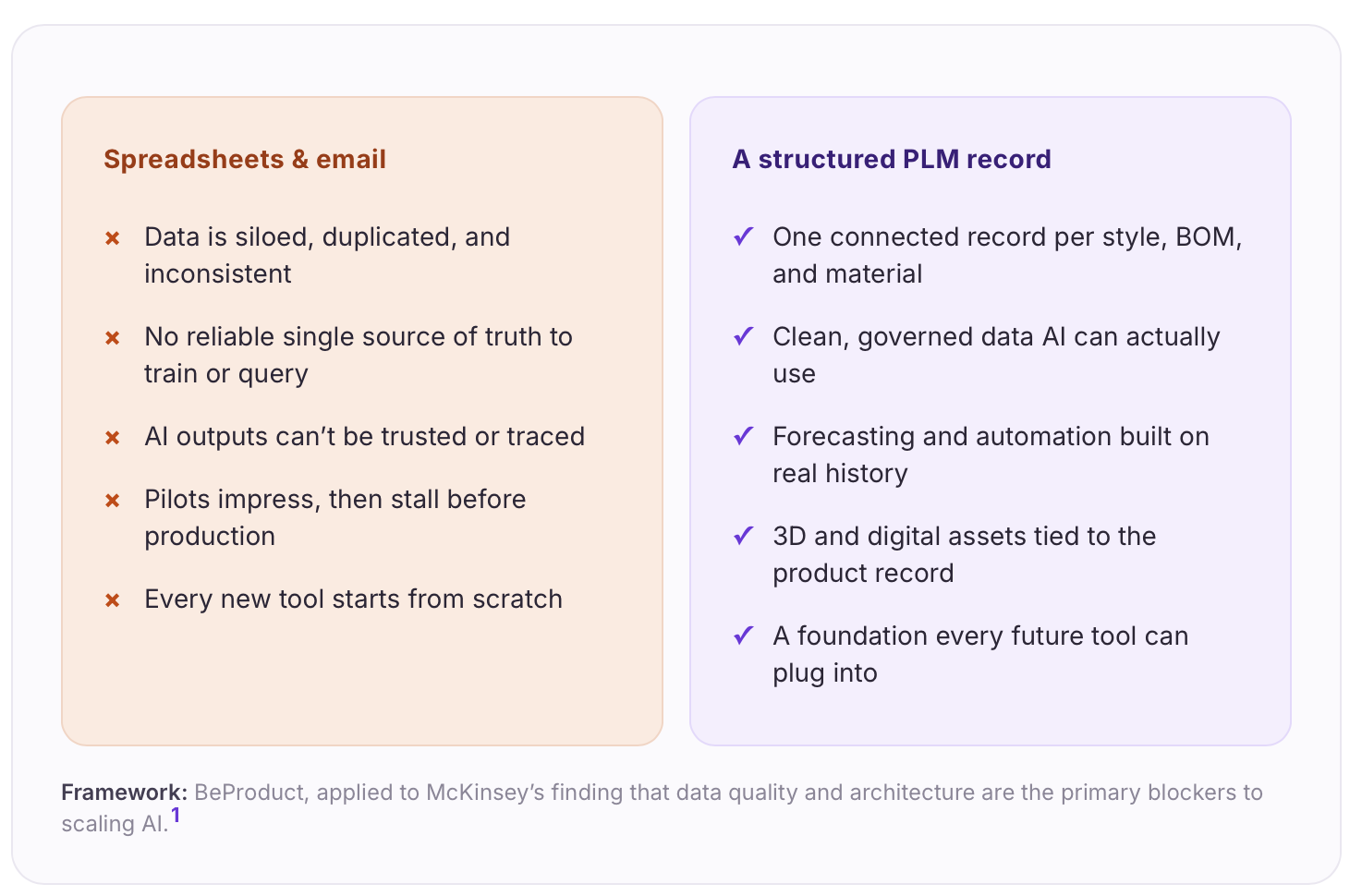
This is why the AI moment is, paradoxically, a PLM moment. The brands that will get real value from forecasting models, automated tech-pack generation, intelligent search across their libraries, and eventually AI agents are the ones who did the unglamorous work first: putting their product data somewhere clean, connected, and structured. As McKinsey’s data shows, the technology was never the constraint. The foundation was.1
The practical sequence
You don’t need an AI strategy before you need a data strategy. Structure the product record first, then AI stops being a series of dead-end pilots and starts compounding. The order matters more than the ambition.
The same backbone problem shows up in 3D. Browzwear’s production-validated digital twins are built on certified mill data and physics-based simulation, and CLO’s virtual garments depend on clean, connected inputs, structured data that becomes a powerful asset on a real record and useless noise scattered across files. The 3D engines fashion is betting on need the same backbone the AI does.67
The takeaways
Adoption is universal; scaling is rare. 88% of organizations use AI, but only ~⅓ have scaled and ~6% see real EBIT impact.
The top blocker is data, not the model specifically the siloed spreadsheets and legacy systems most teams run on.
Fashion’s ambition is high but its data is messy, scattered across files, drives, and inboxes per style.
PLM is the backbone AI requires. Structure the product record first, and AI shifts from stalled pilots to compounding value.

REFERENCES
McKinsey & Company, “The State of AI in 2025: Agents, innovation, and transformation” (88% regular AI use; ~⅓ scaling; ~6% high performers with >5% EBIT; data quality and architecture as the leading scaling blocker). mckinsey.com/the-state-of-ai
McKinsey & Company & The Business of Fashion, “The State of Fashion 2026” (35%+ of fashion/luxury players using gen AI; call to move beyond small pilots toward fundamental change). mckinsey.com/state-of-fashion
McKinsey & Company & The Business of Fashion, “The State of Fashion 2025” (75% of fashion executives prioritizing AI for forecasting, inventory and cost control; 45% citing AI-driven marketing). mckinsey.com/state-of-fashion-2025
R. Panko, University of Hawaii, “What We Know About Spreadsheet Errors” (~88% of operational spreadsheets contain errors — context for the cost of unstructured product data). panko.shidler.hawaii.edu
BeProduct, platform overview (centralizing product data, libraries, tech packs and 3D assets into a single record). beproduct.com/plm
CLO Virtual Fashion (CLO3D), a BeProduct 3D/DPC integration partner — product and ESG positioning (true-to-life virtual garment visualization; virtual sampling and remote collaboration shorten time-to-market; designing in virtual garments reduces sample production, shipment, and material waste). clo3d.com
Browzwear, a BeProduct 3D/DPC integration partner — company blog and product information (brands report up to 95% first-time-right samples and up to 80% fewer physical sampling rounds; late-stage design changes cost up to ~10× more than at concept stage; production-validated digital twins built on certified mill data; Fabric Analyzer measures physical fabric properties; assets export to PLM/ERP). browzwear.com/blog
Percentages from McKinsey reflect cross-industry survey data; fashion-specific figures are drawn from the BoF-McKinsey State of Fashion series. Chart bar lengths in Figure 2 illustrate the relative emphasis of each blocker, not precise survey values.